
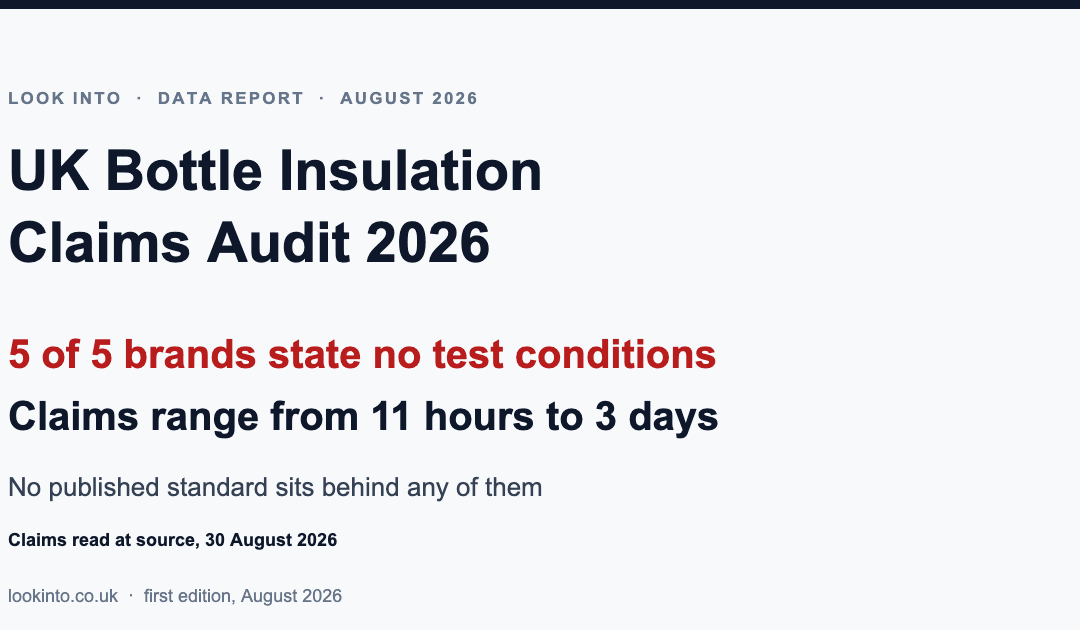
Every insulated bottle is sold on a number. Twenty-four hours cold. Two days iced. Twelve hours hot. This audit asks a simpler question than which number is biggest: what does any of them actually mean?
The finding: we read the insulation claim on five major brands at source, and not one stated a single test condition. No starting temperature. No room temperature. No fill level. No threshold for when a drink stops being cold. The numbers are real in the sense that the brands publish them. They are not comparable with each other in any meaningful way.
What each brand claims, and what it tells you about the test
Claims taken from each brand’s own website on 30 August 2026, not from a retailer listing. The middle column is the claim in the brand’s own words.
| Brand | The claim, in their words | Test conditions published | Read at |
|---|---|---|---|
| Chilly’s Series 3 / Series 3 Flip | Keeps Drinks Ice Cold For Up To 24 Hours; Series 3 Flip: UP TO THREE DAYS COLD | None stated | Source |
| Stanley Quencher travel tumbler 40 oz | Stays cold for 11 Hrs; stays cold with ice for 2 Days | None stated | Source |
| Hydro Flask Standard Mouth 24 oz | 24 hours cold, 12 hours hot | None stated | Source |
| Thermos FUNtainer | Our FUNtainer bottles keep beverages cold for up to 12 hours | None stated | Source |
| Owala Stainless steel range | No hours claimed. States only that bottles are triple-layer insulated | No figure to condition | Source |
Owala is the odd one out, and to its credit. Its FAQ describes the construction (“triple-layer insulated”) and declines to attach an hours figure to it at all. That is a more honest position than a number with nothing behind it.
What the missing conditions actually change
Four things decide how long a bottle holds temperature, and not one of them appears in the claims above. The starting temperature matters, because liquid poured in at 2°C and liquid poured in at 8°C will not last the same time, and no brand says which it used. The room matters too: a bottle assessed in an 18°C office is a different bottle from one left in a 30°C car. So does the fill level, because a part-full bottle carries a slug of air that warms the liquid from the inside, which makes full and half-full effectively two different products.
The loosest of the four is the threshold. “Cold” has no definition here. If a brand counts 15°C as still cold, a long number is easy to reach.
The standard that would fix this does not exist yet
There is a live proposal to create one. ISO/NP 8442-10, “Materials and articles in contact with foodstuffs, Cutlery and table holloware, Part 10: Requirements for Stainless steel vacuum container”, would set requirements and test methods for stainless steel vacuum containers for domestic use, including insulation performance for both heat and cold.
It is at New Proposal stage, which means it is not a standard yet. The reason given for proposing it is the point of this whole page: the proposal states that most countries do not have corresponding product standards, and that there are no unified international standards for this type of product. Until that changes, every hours figure on every bottle is a manufacturer’s own measurement, taken its own way, with the method unpublished.
What to do with that
Buy on the things that are checkable instead. Capacity, weight, whether the lid actually locks for a bag, whether the mouth takes ice cubes, whether the steel is 18/8, and what the warranty says. Those are verifiable before you buy. The hours number is not, and treating it as a spec sheet rather than a slogan is the mistake the category invites.
If a brand ever does publish its conditions, that is worth more than a bigger number. It would be the first one you could actually check.
Method
We opened each brand’s own website on 30 August 2026 and recorded the insulation claim as written, then looked on the same page and its FAQ for any statement of starting temperature, ambient temperature, fill level or threshold. Retailer listings and Amazon bullet points were not used, because those are written by sellers rather than by the manufacturer. Where a brand publishes different figures for different products we recorded the product named in the table.
This is an audit of published claims. It is not a thermal test and we have not timed any bottle. Nothing here says which bottle performs best, because nothing published lets anyone say that.
Changes
None. This is the first edition and the table above is the baseline.
The data
Free to reuse with credit.
Show the 2026 audit as CSV
brand,product,claim,starting_temp_stated,ambient_temp_stated,fill_level_stated,threshold_stated,read_at
Chilly's,"Series 3 / Series 3 Flip","Keeps Drinks Ice Cold For Up To 24 Hours; Series 3 Flip: UP TO THREE DAYS COLD",No,No,No,No,2026-08-30
Stanley,"Quencher travel tumbler 40 oz","Stays cold for 11 Hrs; stays cold with ice for 2 Days",No,No,No,No,2026-08-30
Hydro Flask,"Standard Mouth 24 oz","24 hours cold, 12 hours hot",No,No,No,No,2026-08-30
Thermos,"FUNtainer","Our FUNtainer bottles keep beverages cold for up to 12 hours",No,No,No,No,2026-08-30
Owala,"Stainless steel range","No hours claimed. States only that bottles are triple-layer insulated",n/a,n/a,n/a,n/a,2026-08-30
Questions people ask
Do insulated water bottle claims mean anything?
Not as a comparison. We read the insulation claim on five major brands at source and none of them stated a single test condition: no starting temperature, no room temperature, no fill level, and no threshold for when a drink stops counting as cold. Two bottles both claiming 24 hours could have been assessed in completely different ways, and nothing published lets you tell.
Is there an official test standard for vacuum flasks?
Not yet. ISO/NP 8442-10 would set requirements and test methods for stainless steel vacuum containers, including insulation performance for heat and cold. It is at New Proposal stage, and the proposal itself says most countries have no corresponding product standard and there are no unified international standards for this type of product. Until it lands, the hours on the box are the manufacturer’s own number, measured its own way.
Which brand keeps drinks cold longest?
We cannot tell you, and neither can anyone quoting the box. The claims range from 11 hours to three days, but because the conditions behind them are unpublished, the numbers are not on the same scale. A brand claiming three days has not necessarily beaten one claiming 24 hours; it may simply have used a gentler test.
What actually changes how long a bottle stays cold?
Opening the lid, how full the bottle is, and how warm the room is. A part-full bottle has more air in it to warm the liquid, and every opening swaps cold air for warm. None of the claims we read state any of those three things, which is precisely why they cannot be compared.
Has Look Into tested these bottles?
No. This is an audit of what the brands publish, not a thermal test, and we have not timed any bottle. If we ever run one we will publish the conditions, which is the thing currently missing from every claim on this page.
Where to go next
For the buying side, on the things you can actually verify: our guide to insulated water bottles. For the same treatment applied to a different category of unverifiable marketing, see the At-Home Beauty Device Cost Index.
Other Look Into indexes
Each of these is built the same way: a fixed basket or a fixed set of claims, captured on a stated date, with the method published and the raw data on the page.
- UK Student Kit Index 2026, a fixed 20-item basket priced against the maintenance loan.
- UK At-Home Beauty Device Cost Index 2026, IPL devices and LED masks costed per session.
- UK Home Security Value Index 2026, hardware priced against how burglars actually get in.
Sources
Brand claims read at source on 30 August 2026: Chilly’s, Stanley, Hydro Flask, Thermos, Owala. Standards status: BSI Standards Development, ISO/NP 8442-10. This page carries no affiliate links, because it does not recommend a product.