

Fans are the cheapest way to get through a UK heatwave, running on pennies an hour where air conditioning runs on pounds. The trick is matching the fan to the room, because a quiet bedroom fan and a fan that can cool an open-plan living room are rarely the same machine. Here are five worth buying in 2026.
How Look Into made this guide: desk research, not a hands-on test. We shortlist on UK availability, compare published specifications and warranty terms, and read verified UK owner reviews, discounting incentivised ratings. Prices in the comparison table are pulled live from Amazon UK. Look Into has not handled these products: every figure comes from the maker, the listing or a named source, read on the date shown.
Prices in this table come from Amazon and are refreshed at least once a day, with the date of the last update under the table. The cost-per-use and running-cost figures on this page use prices Look Into read on 26 June 2026, so they can differ from today's price.




As an Amazon Associate, Look Into earns from qualifying purchases. Product prices and availability are accurate as of 25 October 2026 and are subject to change.
Prices and specs last checked by Look Into on 26 June 2026 · next check 16 March 2027 · how we picked
The short version
For most rooms, the Shark FlexBreeze. For a bedroom, the MeacoFan 1056P. For near silence, the Duux Whisper Flex. For app control, the Dreo 519S. For a big, open space, the Shark TurboBlade.
How they compare
| Fan | Type | Best for |
|---|---|---|
| Shark FlexBreeze | Corded/cordless | All-round use |
| MeacoFan 1056P | Circulator | Quiet bedrooms |
| Duux Whisper Flex | Tower | Near silence |
| Dreo 519S | Smart tower | App control |
| Shark TurboBlade | Bladeless | Large rooms |
The fans worth buying
Shark FlexBreeze
Best all-rounderRuns corded at home or cordless in the garden, pushes plenty of air, and takes a misting attachment for the really hot days. This is the fan most people should just buy.
The catch: The cordless version costs more, and at full speed it is not the quietest in this list.
Corded or cordless, indoor and outdoor

As an Amazon Associate, Look Into earns from qualifying purchases. Product prices and availability are accurate as of 25 October 2026 and are subject to change.
MeacoFan 1056P
Best for bedroomsAn air circulator that is Quiet Mark certified and very efficient, with oscillation that moves air around the whole room instead of just blowing at you. It sits near 20 decibels on low.
The catch: It is a squat circulator rather than a tall tower, so it looks more functional than sleek.
around 20 dB on low, oscillating · around £110
Check price on AmazonDuux Whisper Flex
QuietestAbout 13 decibels on its lowest setting and Quiet Mark certified, so it is close to silent. A battery option lets you move it around the house without trailing a cable.
The catch: That near-silence only applies on the lowest speeds, and it costs more than a basic tower fan.
around 13 dB, battery option · around £130
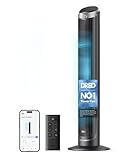
Check price on AmazonDreo Smart Tower Fan 519S
Best smartApp and voice control, wide oscillation and a quiet sleep mode, at a price that undercuts the big names. Useful if you like turning the fan off from bed.
The catch: You are relying on an app and Wi-Fi, which is more to go wrong than a simple dial.
App and voice, oscillating

As an Amazon Associate, Look Into earns from qualifying purchases. Product prices and availability are accurate as of 25 October 2026 and are subject to change.
Shark TurboBlade
Best for big roomsA bladeless design with two vents that pivot almost anywhere and throw air up to 20 metres, so it reaches across a large or open-plan room that a normal fan cannot.
The catch: It is the priciest fan here and takes up more room than a slim tower.
Bladeless, airflow up to 20 m
As an Amazon Associate, Look Into earns from qualifying purchases. Product prices and availability are accurate as of 28 August 2026 and are subject to change.
How to choose one
Start with the room. In a bedroom, noise matters most, so look for a Quiet Mark badge or a stated decibel figure on the lowest speed. In a large or open-plan space, reach and airflow matter more, which is where a circulator like the MeacoFan or a bladeless thrower like the TurboBlade earns its keep. Oscillation spreads the breeze around, a timer and sleep mode help overnight, and app control is a nice extra rather than a reason to buy.
What they cost to run
Fans are cheap to run, usually 30 to 60 watts, or about 1 to 2 pence an hour. If a fan still is not enough on the hottest, stickiest nights, that is the point to look at a portable air conditioner instead.
Common questions
Are tower fans better than pedestal fans?
Tower fans take up less floor space and look tidier. Pedestal fans usually push more air and let you set the height. For a bedroom or living room a good tower or circulator fan is plenty; for a large, hot room, the raw airflow of a pedestal or a circulator like the MeacoFan can win.
What is the quietest fan for sleeping?
The Duux Whisper Flex at around 13 decibels and the MeacoFan 1056P at around 20 decibels on low are among the quietest sold in the UK, and both are built with bedrooms in mind.
Do fans actually cool a room?
A fan does not lower the air temperature. It moves air over your skin so you feel cooler, which is enough on most UK nights. On a genuinely hot, humid day you may want a portable air conditioner.
Are fans cheap to run?
Very. Most use 30 to 60 watts, which works out at roughly 1 to 2 pence an hour, far less than a portable air conditioner.
Want cooling you can carry? See our take on the viral neck fans, or browse more Home & Garden picks.
Related reading: how to cool a bedroom in a heatwave, and what fans, air con and dehumidifiers cost to run.
This page is part of Look Into's UK household cost research. For the costed figures behind it, with capture date, method and sources, see the cost-per-degree cooling analysis.