
What everything in your home costs to run right now
Every figure on this page is worked out from the Ofgem price cap in force today, 1 October to 31 December 2026. When Ofgem changes the cap, this page changes with it.
Look Into is published by Whito Ltd, company 10918465. This page carries no affiliate links and recommends no product; the method is shown in full further down the page.
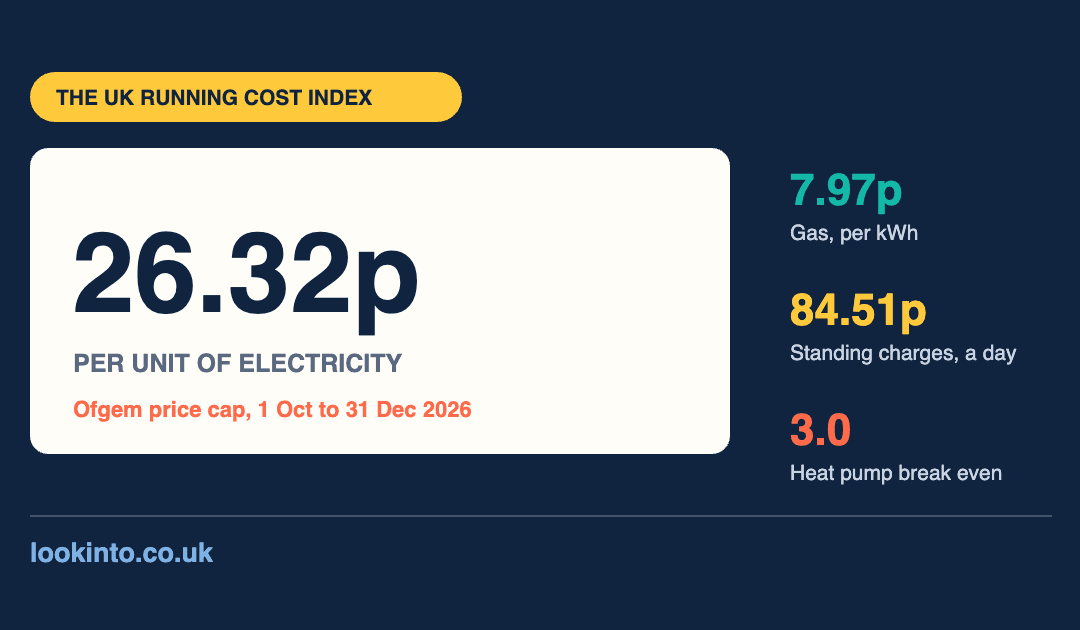
The short answer. At the Ofgem price cap for 1 October to 31 December 2026, electricity costs 26.32p per kWh, so an appliance drawing 1,000W costs 26.32p for every hour it runs. A 3kW kettle costs about 4p a boil and a 2.5kW tumble dryer about 99p for a 90 minute cycle. Standing charges add £308.46 a year on a dual fuel bill before anything is switched on. Fridges are the row most tables get wrong: the Energy Saving Trust puts a fridge freezer at around £80 a year, not the £692 a 24 hour wattage sum suggests. Figures from the Look Into UK Running Cost Index, revised 2 October 2026.
The £308 you pay before you switch anything on
Most running cost advice starts with the unit rate. The unit rate is the second thing that happens to your bill.
A dual fuel household on a standard variable tariff pays 54.83p a day for the electricity connection and 29.68p a day for the gas connection. That is 84.51p a day, or £308.46 a year, charged whether the house is occupied or empty, whether the heating is on or the fuse box is off. Under the cap that ran from July to September 2026 the same connections cost £314.74 a year in standing charges before a unit is used; the October rates trim that by £6.28.
Spread over a typical home's use, that standing charge turns a 26.32p unit into 34.33p. What the rest of the £1,723 buys, in heater hours, dryer cycles and air fryer cooks, is worked through in what the price cap really buys.
That sets a floor under every saving on this page. A habit costing £40 a year cannot be cut to zero, only down to your share of the standing charge. An empty flat, a holiday home or a garage supply still generates a bill. It is also why swapping one appliance moves the total less than most people expect.
| What you pay | Electricity | Gas | Both |
|---|---|---|---|
| Standing charge, per day | 54.83p | 29.68p | 84.51p |
| Standing charge, per year | £200.13 | £108.33 | £308.46 |
| Unit rate, per kWh | 26.32p | 7.97p | n/a |
Ofgem price cap, direct debit, average across England, Scotland and Wales, 1 October to 31 December 2026. Your own rate varies by region and by how you pay. Prepayment and standard credit rates differ.
Cost per hour and cost per use, at today's rate
Power ratings come from the Centre for Sustainable Energy's published figures. The costs are ours, recalculated at the October rate of 26.32p.
| Appliance | Power | Per hour | Typical use | Per use |
|---|---|---|---|---|
| Electric shower | 9,000W | £2.37 | 10 minutes | 39p |
| Immersion heater | 3,000W | 79p | 1 hour | 79p |
| Kettle | 3,000W | 79p | 3 minute boil | 4p |
| Tumble dryer | 2,500W | 66p | 90 minute cycle | 99p |
| Portable electric heater | 2,500W | 66p | 1 hour | 66p |
| Electric oven | 2,100W | 55p | 1 hour | 55p |
| Washing machine | 2,100W | 55p | 1 hour cycle | 55p |
| Oil filled radiator | 2,000W | 53p | 1 hour | 53p |
| Hairdryer | 2,000W | 53p | 10 minutes | 9p |
| Electric hob ring | 2,000W | 53p | 30 minutes | 26p |
| Grill | 1,500W | 39p | 15 minutes | 10p |
| Iron | 1,500W | 39p | 30 minutes | 20p |
| Toaster | 1,000W | 26p | 4 minutes | 2p |
| Microwave | 1,000W | 26p | 10 minutes | 4p |
| Electric lawnmower | 1,000W | 26p | 30 minutes | 13p |
| Vacuum cleaner | 900W | 24p | 20 minutes | 8p |
| Dehumidifier | 500W | 13p | 8 hours | £1.05 |
| Heated towel rail | 450W | 12p | 4 hours | 47p |
| Electric blanket | 150W | 4p | 1 hour | 4p |
| Desktop computer | 140W | 4p | 8 hours | 29p |
| Games console | 120W | 3p | 3 hours | 9p |
| Television, LCD or LED | 120W | 3p | 4 hours | 13p |
| Laptop | 50W | 1p | 8 hours | 11p |
| TV box or set top box | 40W | 1p | 24 hours | 25p |
| Extractor fan | 20W | under 1p | 1 hour | under 1p |
| Broadband router | 10W | under 1p | 24 hours | 6p |
Power ratings as published by the Centre for Sustainable Energy, last updated July 2026. Costs recalculated by Look Into at the current capped rate of 26.32p per kWh. Usage times are our stated assumptions and are there so the arithmetic is visible, not because every household runs an iron for exactly half an hour.
For councils and advice services: this table is available as a one page PDF for October to December 2026, free to reproduce on your own pages or in print with credit to Look Into. We reissue it within 72 hours of each price cap change. The next change is on 1 January 2027.
Not in the table, because it charges a battery rather than drawing power while you use it: an e-bike. A 720Wh battery costs about 19p to fill from empty at this rate, before charger losses; the electric bikes guide prices six of them from their own stated batteries. The full method, per mile and per year, is in what it costs to charge an e-bike.
The row that every running cost table gets wrong
Fridges and freezers.
A fridge freezer is usually listed at 300W and a freezer at 150W, and those numbers are real. They are the draw of the compressor while the compressor is running. A fridge compressor does not run continuously. It cycles, and the share of the day it spends running depends on the model, the room temperature, how full it is and how often the door opens.
Multiply 300W by 24 hours at the October 2026 rate and you get £1.90 a day, or £692 a year, for a fridge freezer (£1.88 and £686 at the July to September 2026 cap). That figure is wrong by roughly an order of magnitude, and it circulates widely. The Energy Saving Trust puts a 424 litre F rated fridge freezer at around £80 a year, and an A rated dishwasher at £35 a year against £70 for a G rated one.
The general rule: for anything that cycles on a thermostat rather than running flat out, the rated power tells you almost nothing about the annual cost. That covers fridges, freezers, dehumidifiers on humidistat control, and any heater with a thermostat. Use the annual figure on the energy label instead, which is measured over a standardised year rather than assumed.
Why the air fryer is cheaper, and when it stops being cheaper
The most repeated saving on this list, examined.
A single basket air fryer rated at 1,500W, run for half an hour, costs about 20p. An hour in a 2,100W oven costs about 55p. The air fryer earned its reputation on that gap, and the gap is real.
The reason is volume. An air fryer heats a five litre box and starts cooking straight away. An oven heats a sixty litre cavity and spends ten minutes getting there. Every penny of the saving comes from the size of the space being heated, which is the same reason a microwave beats an air fryer for anything it can cook, and a single hob ring beats both for one pan.
It also means the advantage runs out. Cooking for four and running three or four baskets back to back puts you level with the oven, and past that the oven wins. The rule that survives is to heat the smallest space that will do the job, whichever appliance that turns out to be.
The 1,500W figure is a typical rated power from UK retail listings rather than one of the Centre for Sustainable Energy figures used elsewhere on this page. Dual basket models draw considerably more, often over 2,000W.
Six habits, priced over a year
Cost per hour is interesting. Cost per year is what shows up on the bill.
| Habit | The assumption | A year |
|---|---|---|
| Dehumidifier through the damp season | 500W, 8 hours a day, October to March | £191.61 |
| Heated towel rail on a timer | 450W, 4 hours a day, all year | £172.92 |
| Tumble drying three loads a week | 2,500W, 90 minute cycle | £153.97 |
| A daily electric shower | 9,000W, 10 minutes | £144.10 |
| Boiling the kettle five times a day | 3,000W, 3 minutes a boil | £72.05 |
| The broadband router, never switched off | 10W, 24 hours a day | £23.06 |
All at 26.32p per kWh. These are worked examples using the power ratings in the table above, not measurements of any particular household.
Two figures from the Energy Saving Trust are worth setting alongside these. Taking devices off standby saves a typical household around £45 a year, and replacing halogen bulbs with LEDs saves around the same. Both are one off actions rather than habits, which makes them better value per unit of effort than anything in the table above.
What a unit of heat costs, gas against a heat pump
One number decides this, and it is not the unit rate.
Gas and electricity are not comparable per kWh, because neither delivers a full kWh of heat for every kWh you buy. A gas boiler loses some up the flue. A heat pump does the opposite and moves more heat than the electricity it consumes. So the honest comparison is cost per kWh of heat delivered into the house.
The Energy Saving Trust puts an A rated boiler at 90 per cent efficient, and a heat pump at 300 to 400 per cent. At the October capped rates:
| System | Efficiency | Cost per kWh of heat |
|---|---|---|
| Gas boiler, A rated | 90% | 8.86p |
| Heat pump, poor performance | 250% | 10.53p |
| Heat pump, low end of EST range | 300% | 8.77p |
| Heat pump, break even against gas | 297% | 8.86p |
| Heat pump, mid range | 350% | 7.52p |
| Heat pump, high end of EST range | 400% | 6.58p |
The number to remember is 3.0. At 26.32p for electricity and 7.97p for gas, a heat pump has to average a seasonal efficiency of about 3.0 to break even with a 90 per cent gas boiler on fuel cost alone. Under the July to September rates that break even point sat at a SCOP of 3.21; the October cap moves it to 2.97, because gas rose faster than electricity. Below that it costs more to run. Above it, it costs less, and the gap widens quickly. This is the first quarter on this page where a mid range heat pump at 300 per cent beats a gas boiler outright on fuel cost, 8.77p a kWh of heat against 8.86p. Part of that comes from the temporary removal of VAT from electricity, which ends on 31 March 2027, so the crossover is not a permanent one yet. We explain the timing and the April 2027 cliff in the electricity VAT cut, in pounds.
The calculation leaves out standing charges, so a household that keeps a gas connection for the hob goes on paying £108 a year for it. It also assumes a modern boiler. Older ones run well below 90 per cent, which drags the break even point down. Most importantly, a heat pump on a time of use tariff buys much of its electricity below the capped rate, and that is the main reason real installations beat this arithmetic more often than the table suggests.
This page prices a unit of heat. For what a heat pump costs to run across a whole UK winter, including the radiator and flow temperature side of it, see heat pump running costs.
What moves the total
Published shares of a typical household energy bill.
| Category | Share of a typical bill |
|---|---|
| Washing machines, dishwashers and tumble dryers | 14% |
| Fridges and freezers | 13% |
| Televisions, laptops and games consoles | 6% |
| Lighting | 5% |
| Ovens, microwaves and kettles | 4% |
Energy Saving Trust, page updated 3 August 2026. The shares do not sum to 100 because space heating and hot water, which dominate most bills, sit outside this list.
Your tariff beats every habit on this page
Every figure above is a wattage multiplied by a rate. Only one of those two is easy to change.
A tumble dryer cycle costs 99p at the capped 26.32p. At a 10p off peak rate the same cycle costs 38p. Air drying the washing and shortening the showers both help and are worth doing, and an afternoon spent checking whether you are on the right tariff moves the number that multiplies all of them.
That is also the short version of this whole page. Chase heat. Anything that warms air, water or food is where the pounds are, so that is where the effort belongs: fewer dryer cycles, smaller cooking spaces, shorter showers, and a rate that fits how you actually use electricity. The kettle, the television and the standby lights can keep their dignity.
How these figures are worked out
Two published inputs and one sum. Here is where every part of it came from.
| What | Value used | Where it came from |
|---|---|---|
| Electricity rate and standing charge | 26.32p per kWh, 54.83p a day | Ofgem price cap, direct debit, 1 October to 31 December 2026 |
| Gas rate and standing charge | 7.97p per kWh, 29.68p a day | Ofgem, same period |
| Appliance power ratings | 9,000W down to 10W | Centre for Sustainable Energy, published July 2026 |
| Fridge freezer annual cost, standby and lighting savings, bill shares | £80, £45, £45, 14 to 4 per cent | Energy Saving Trust, published 3 August 2026 |
| Boiler and heat pump efficiency | 90%, 300 to 400% | Energy Saving Trust, published 16 July 2026 |
| Every cost per hour, per use and per year | n/a | Look Into's arithmetic on the rows above |
| Usage times and frequencies | n/a | Assumed, and printed beside every result so you can substitute your own |
The sum behind every figure is the same one: watts divided by 1,000, multiplied by hours, multiplied by the unit rate. The inputs are on the page so you can check the arithmetic yourself.
We have not measured any of these appliances. The power ratings are published figures rather than our own bench tests, and the table above says so instead of leaving you to assume otherwise.
Ofgem sets the cap every three months. The 1 October to 31 December 2026 level was confirmed on 26 August 2026 and every figure above was rebased to it on 28 August. The January to March 2027 level is announced in late November. This page is rebuilt at each cap change and the date at the top moves with it.
Related: if you receive the Winter Fuel Payment, we worked out how many kWh of heating £200 actually buys at the October 2026 cap.
Sources: Ofgem, energy price cap unit rates and standing charges. Centre for Sustainable Energy, how much electricity am I using. Energy Saving Trust, top five energy consuming home appliances, and the in depth guide to heat pumps.
The six that come up most
What does 1 kWh of electricity cost in the UK?
26.32p under the Ofgem price cap for direct debit customers, averaged across England, Scotland and Wales, for 1 October to 31 December 2026. Gas is 7.97p. Your own rate depends on your region, your payment method and whether you are on a fixed tariff rather than the capped standard variable one.
How much does it cost to boil a kettle?
About 4p for a 3 minute boil on a 3,000W kettle. Boiling five times a day for a year comes to roughly £72. Filling the kettle only to the level you need is the whole saving here, and it is a real one because most of the energy goes into heating water you then pour away.
What is the most expensive thing in a normal house?
Per hour, the electric shower at £2.37. Over a year, space heating and hot water, which is why they sit outside the appliance index above. Among appliances the wet ones win, at around 14 per cent of a typical bill.
Does a heat pump cost less to run than a gas boiler?
It depends on one number. At today's capped rates a heat pump needs to average about 3.0 units of heat per unit of electricity to match a 90 per cent efficient gas boiler. Well designed installations on a time of use tariff usually beat that comfortably. A poorly commissioned one in a house with small radiators may not.
Why does my bill have a charge even when I use nothing?
The standing charge. It pays for the network, meter and the cost of supplying customers whose supplier failed. At current levels it is 84.51p a day for a dual fuel home, which is £308.46 a year before a single unit is used.
Is it cheaper to use the microwave or the oven?
The microwave, by a wide margin, for anything it can cook. Ten minutes in a 1,000W microwave costs about 4p. An hour in a 2,100W oven costs about 55p on wattage times time, though a measured oven uses less because its thermostat cycles, as our cheapest way to cook comparison shows. The oven wins only when you are cooking enough at once that the per portion cost falls below the microwave, or when the result would be different food.
We asked four AI assistants which appliances are cheapest to run on 8 October 2026 and scored their answers against these figures. 7 of 17 named a machine within 20% of the cheapest. The results are in the AI Shopping Test.
Free calculators
Related Look Into research
UK Heating Cost Index · UK Always-On Load Index · Home Upgrade Payback Index · UK Standing Charge Postcode Report