

Key takeaways
- Six disposable glove listings sat in Amazon UK’s DIY & Tools top 30 when we read the chart on 6 October 2026, at ranks 2, 3, 4, 13, 19 and 29.
- We read the title and the “About this item” bullets on eight best-selling glove listings. None of the eight names EN ISO 374 or EN 455. Four of them claim chemical protection anyway.
- Those two standards test different things. BS EN 455 is the medical glove series and covers freedom from holes, physical strength, biological safety and shelf life. BS EN ISO 374 is the chemical protection series and covers how long a named chemical takes to get through.
- The cheapest box here works out at 5.0p a glove and the dearest at 12.3p, both for 100 gloves, with prices read on 6 October 2026.
Disposable gloves have quietly taken over the top of Amazon UK’s DIY & Tools chart. When we read it on 6 October 2026, six of the top 30 were boxes of disposable gloves, and three of them held ranks two, three and four. The UNIGLOVES Black Pearl box was number one in Disposable Gloves and number two across the whole department, which for a five quid box of consumables is a lot of volume.
Autumn is part of it. This is the season for stripping wallpaper, clearing gutters, treating the first damp patches and doing the jobs you put off in August, and all of them are jobs people would rather not do bare-handed. Our mould remover roundup ran into the same seasonal spike last week.
So we went through the chart properly. What we found is something none of the pages ranking for “best disposable gloves” mentions, and it changes what you should buy.




As an Amazon Associate I earn from qualifying purchases. (paid link)
Prices and specs last checked 6 October 2026 · next check 1 December 2026 · how we picked
One box, three different sets of rules
A thin blue glove is a thin blue glove. The law disagrees. Depending on what the seller says it is for, the same object can be sold in Britain under three separate regimes, and each one demands a different kind of evidence.
Call it an examination glove and you are selling a medical device. NHS Scotland’s national infection prevention manual lists the test series that applies: BS EN 455-1:2020 for freedom from holes, BS EN 455-2:2015 for physical properties, BS EN 455-3:2015 for biological safety and BS EN 455-4:2009 for shelf life. The conformity route is light. Gov.uk’s guidance on Class I devices says the manufacturer self-certifies, and only brings in a UK Approved Body if the device is sterile or has a measuring function. Nobody else checks the box before it reaches you.
Call it protection against chemicals and you are selling personal protective equipment. Here the standards get specific. The HSE points to EN 374-2 for waterproofness in wet work and EN 374-3 for substances, with EN 388 for mechanical hazards and EN 407 for heat. NHS Scotland cites BS EN ISO 374-1:2016+A1:2018 for protection against dangerous chemicals and BS EN ISO 374-2:2019 and 374-4:2019 for penetration and degradation testing. The number that matters is breakthrough time, which the HSE defines as “the time a chemical takes to permeate through the glove material and reach the inside”. The same page is blunt about the limits: “no glove material will protect against all substances and no gloves will protect against a specific substance forever”. A glove rated for one solvent can be useless against another.
Call it food safe and you are selling a food contact material. Article 15 of retained Regulation (EC) 1935/2004 says materials not yet in contact with food must carry the words “for food contact”, or a specific indication of use such as coffee machine or soup spoon, or the symbol in Annex II. The exception is where the article is obviously meant for food by its nature, which a box of blue gloves is not.
Markings differ too. NHS Scotland’s guidance states that PPE must be UKCA marked. On the medical device side, gov.uk’s timeline allows CE marked devices certified under the EU MDR onto the GB market until 30 June 2030, and devices on the older MDD route until the sooner of certificate expiry or 30 June 2028.
Eight best sellers, not one standard named
We read the product title and the “About this item” bullets on eight best-selling glove listings, and nothing else on the page. That scoping matters. An Amazon product page carries carousels of other people’s products and a pile of related copy, so a word search across the whole page will confirm almost any claim you go looking for. Scoped to each product’s own words, here is what they say.
| Listing | Chart position | Chemical claim | Food claim | EN standard named |
|---|---|---|---|---|
| UNIGLOVES Black Pearl Nitrile Examination | 2 in DIY & Tools | Yes | Yes | No |
| PRAIMA Black Nitrile Disposable | 3 in DIY & Tools | Yes | Yes | No |
| by Amazon Blue Disposable Nitrile | 4 in DIY & Tools | No | Yes | No |
| PRAIMA Surgicals Food Grade Nitrile | 13 in DIY & Tools | No | Yes | No |
| PRAIMA Clear Vinyl | 19 in DIY & Tools | No | Yes | No |
| by Amazon Disposable Vinyl | 29 in DIY & Tools | No | No | No |
| TG Tough Glove BOA PRO Nitrile | 1 in Chemical Resistant Gloves | Yes | No | No |
| Ansell TouchNTuff 92-600 | 89 in Disposable Gloves | Yes | Yes | No |
Zero out of eight. Four of the eight tell you in their own copy that the glove protects against chemicals, and not one of them says which chemicals, to what rating, or for how long. The sharpest version of this is the TG Tough Glove BOA PRO, which is the number one seller in Amazon’s own Chemical Resistant Gloves subcategory and names no EN ISO 374 rating anywhere in its listing. One listing out of eight, the UNIGLOVES box, uses the word AQL at all, and it attaches no number to it, which leaves the term doing nothing.
The food side is the same shape. Six of the eight mention food use. None uses the Article 15 wording “for food contact” in its own copy.
One thing we are not saying is that these gloves are uncertified. A listing that stays quiet about a standard tells you about the listing, not about the box. Ansell’s TouchNTuff 92-600 is a professional chemical-handling line and its physical packaging carries the markings, yet its Amazon page does not repeat them either. The honest conclusion is narrower and more useful: the Amazon product page is not a place where you can check this, so if the glove is going near a solvent or a raw chicken, buy from a listing that states the standard or check the box when it arrives and send it back if it is bare.
How we picked these
We started from Amazon UK’s DIY & Tools best seller chart on 6 October 2026 and pulled every disposable glove in the top 30, then added two more from search to cover jobs the chart leaders do not do. Every ASIN was opened and the product title read straight off the page, so nothing here is a guessed link. Prices and stock were read the same morning. We have not laboratory tested these gloves and we do not claim to have. What we have done is read what each one promises in its own words, and check that against the UK rules that govern the promise.
At a glance
| Product | Best for | Pack | Price | Per glove |
|---|---|---|---|---|
| UNIGLOVES Black Pearl Nitrile | Mixed jobs around the house | 100 | £5.92 | 5.9p |
| by Amazon Blue Nitrile | Cheap bulk cleaning | 100 | £5.20 | 5.2p |
| PRAIMA Surgicals Food Grade Nitrile | Kitchen prep | 100 | £5.99 | 6.0p |
| TG Tough Glove BOA PRO | Car and DIY jobs | 100 | £11.47 | 11.5p |
| Ansell TouchNTuff 92-600 | Solvent and chemical splash | 100 | £12.29 | 12.3p |
| PRAIMA Clear Vinyl | Short, clean, low-risk tasks | 100 | £4.99 | 5.0p |
The six we would actually buy
UNIGLOVES Black Pearl Nitrile Examination Gloves, box of 100
The chart leader, at number one in Disposable Gloves and number two across the whole DIY & Tools department on the morning we looked. At £5.92 a box it is 5.9p a glove, and the listing covers the broadest spread of uses of anything here, naming dentistry, healthcare, tattooing and gardening. The word examination in the name is doing real work: it means the maker is selling this as a medical device rather than a general-purpose glove, which brings the BS EN 455 series into play. Black also hides stains, which is why it is the one most people reach for when the job is grubby rather than clinical.
The catch: its own bullets say it is resistant to a wide range of chemicals, and then name no EN ISO 374 rating, no chemical and no breakthrough time. It is also the only listing of the eight to use the word AQL, with no figure attached. Black is good at hiding dirt and equally good at hiding a split.
by Amazon Blue Disposable Nitrile Gloves, pack of 100
Number four in the department and 5.2p a glove, which makes it the cheapest nitrile on this page. If gloves are something you get through rather than something you choose, this is the sensible default. Blue is the right colour for anything food-adjacent because a fragment that comes off is visible against most food, which is the reason catering kitchens standardised on it. Powder free and latex free, so it suits a household where someone reacts to latex.
The catch: the listing states no standard of any kind, names no thickness, and makes no chemical claim, which at least means it is not promising something it has not evidenced. It is thin, so it is a cleaning and food-prep glove rather than a workshop one. The listing we priced is size M, so check you are on the right size variant before you order.
PRAIMA Surgicals Powder Free Nitrile Gloves, Food Grade, 100 count
Number 13 in the department and 6.0p a glove. This is the one of the six that puts food use in the product title rather than burying it in a bullet, so if you are buying gloves mainly for boning a chicken, handling chillies or dyeing something in the kitchen sink, it is the obvious pick. Blue again, powder free, and the same thin nitrile feel as the Amazon basic.
The catch: food grade is a marketing phrase, not a legal one. The legal wording under Article 15 is “for food contact”, or the glass-and-fork symbol, and neither appears in this listing’s own copy. That does not make the claim false. It does mean you are taking the seller’s word for it until the box turns up, so look for the symbol on the carton and return it if there is nothing there.
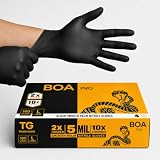
TG Tough Glove BOA PRO Black Nitrile Gloves, 100 pack
The thickest glove here, and the only one that states a thickness at all: the listing says 5 mil at the finger and 4 mil at the palm. That is roughly double the typical examination glove, and it is the difference between a glove that survives an oil change and one that tears on the sump plug. At £11.47 you are paying 11.5p a glove, about twice the chart leaders, which is fair for a glove you can actually work in. It holds number one in Amazon’s Chemical Resistant Gloves subcategory.
The catch: it is the number one seller in a subcategory called Chemical Resistant Gloves and its listing names no EN ISO 374 rating, no tested chemical and no breakthrough time. For oil, grease and grime that hardly matters. For paint stripper or brake cleaner it matters a great deal, and this listing gives you nothing to check against.
Ansell TouchNTuff 92-600, 100 pieces
The outlier, and the reason it is here is that it comes from the industrial glove trade rather than the Amazon marketplace. Ansell sells the 92-600 as a professional chemical-handling glove and the physical packaging carries the markings that go with that, which is not something you can say about most of this chart. At 12.3p a glove it is the dearest thing on the page, and it sits down at number 89 in Disposable Gloves while untested claims hold the top four. If you are stripping paint, mixing resin or handling anything with a hazard pictogram, this is the one to buy.
The catch: more than twice the price of the chart leaders, and its Amazon listing is no more informative than theirs, with no EN number in the title or bullets. The green colour also looks wrong in a kitchen, and the fit is cut for industrial use rather than dexterity, so it is a poor choice for fiddly work.
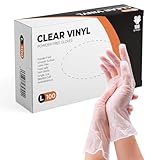
PRAIMA Clear Vinyl Gloves, 100 count
The cheapest box on the page at 5.0p a glove, and number 19 in the department, so plenty of people are buying it. Vinyl is a different polymer from nitrile and it has one genuine advantage: it is the cheapest way to keep your hands clean for two minutes at a time, which is why it turns up in hair dye kits and sandwich counters. If the job is short, dry and nothing worse than mess, you do not need to spend more.
The catch: it is vinyl, and the listing names no standard at all, so there is nothing here to tell you how it performs against oils, solvents or punctures. Treat it as a barrier against mess rather than a barrier against anything that would hurt you, and step up to nitrile the moment the job involves a chemical.
Common questions
Is nitrile better than vinyl?
For almost everything a household does, yes. Nitrile is the material the chemical protection standards are normally written around, and every glove in Amazon UK’s DIY top four is nitrile rather than vinyl. Vinyl earns its place on price for short, dry, low-risk handling. The honest answer for both is that neither listing we read states a standard, so the material tells you more than the page does.
What does AQL mean on a glove box?
Acceptable Quality Level, and it comes from the pinhole test in the BS EN 455-1 series, which covers freedom from holes in single-use medical gloves. A lower AQL figure means a tighter limit on how many gloves in a sampled batch may leak. The figure is the whole point, so a listing that prints AQL with no number after it, as one of the eight here does, has told you nothing.
Can I use DIY gloves for food?
Not on the strength of the Amazon listing alone. Article 15 of retained Regulation (EC) 1935/2004 requires materials intended for food contact to carry the words “for food contact”, a specific indication of use, or the glass-and-fork symbol from Annex II, unless the article is obviously meant for food by its nature. A box of workshop gloves is not. Check the carton for the symbol when it arrives.
Will disposable gloves protect me from paint stripper or white spirit?
Only if the glove has been tested against that substance, and the HSE is direct about why. It defines breakthrough time as the time a chemical takes to permeate the material and reach the inside, and says plainly that no glove material protects against all substances and none protects against a given substance forever. A thin disposable glove used with a strong solvent can be through in minutes. For that kind of job you want a glove whose listing or box states an EN ISO 374 rating.
So what should I actually look for on the box?
Three things, depending on the job. For medical or clinical handling, a BS EN 455 reference and an AQL figure with a number. For chemicals, a BS EN ISO 374 reference with the tested chemicals listed. For food, the words “for food contact” or the glass-and-fork symbol. If the box carries none of them and the job is more than mess, buy something else.
Sources
- NHS Scotland National Infection Prevention and Control Manual, PPE: gloves literature review
- HSE, Selecting protective gloves
- Gov.uk, Medical devices: conformity assessment and the UKCA mark
- Gov.uk, Guidance on Class I medical devices
- Gov.uk, Timelines for acceptance of CE marked medical devices in Great Britain
- Regulation (EC) No 1935/2004, Article 15, labelling
- Food Standards Agency, Food contact materials
- Amazon.co.uk Best Sellers, DIY & Tools
Prices and chart positions were read on amazon.co.uk on 6 October 2026 and change constantly. Look Into is a participant in the Amazon EU Associates Programme and earns from qualifying purchases, which costs you nothing extra. We have not laboratory tested these gloves and say so plainly above.