
The short answer (prices checked 15 October 2026)
- Cheapest per litre of mist: Provirtec MistFree evaporative, £79.99. It states 12 watts and 330ml an hour, which works out at 1.0p of electricity for every litre it puts into the air. It is the dearest machine here and the cheapest to run.
- Cheapest that states its numbers: Amazon Basics 3L top fill, £26.96. It states 25 watts and 244ml an hour, so 2.7p a litre and 7.9p for a twelve hour night.
- The one Britain is buying: Dreo with sensor, £33.38, at number 2 in the Humidifiers chart when we looked. 29 watts and 250ml an hour, so 3.1p a litre.
- Start here instead: TempPro TP50 thermo-hygrometer, £8.49. It tells you what the humidity in the room already is, which is the question the other five cannot answer.
- The audit finding: of the first 20 unsponsored Amazon UK results for "humidifier" on 15 October 2026, not one states a target or recommended indoor humidity. Nine state no wattage. Four carry a 120 volt spec on a UK listing.
Prices in this table come live from Amazon and can change through the day. Prices quoted in the text were checked by Look Into on 15 October 2026, so the two can differ.




As an Amazon Associate I earn from qualifying purchases. (paid link)
Humidifiers turn up in the UK charts at the same moment central heating does. On 15 October 2026 the Dreo Humidifier with Sensor sat at number 2 in Amazon UK's Humidifiers chart and at number 22 in the wider Heating, Cooling & Air Quality chart, the only humidifier in that top thirty. Heating a cold, damp house warms the air faster than it adds water to it, the relative humidity falls, and people wake up with a dry throat and start shopping.
What almost no page about humidifiers will tell you is that the same chart, on the same day, was mostly selling the opposite machine. That matters more than any feature comparison, so it goes first.
Prices and specs last checked by Look Into on 15 October 2026 · next check 10 December 2026 · how we picked
Britain is buying the opposite appliance
We counted the Amazon UK Heating, Cooling & Air Quality best sellers on 15 October 2026. Of the top thirty, 17 products take water out of the air: disposable moisture absorbers at numbers 1, 2, 4, 6, 13, 17, 20, 24, 26 and 28, wardrobe and car bags at 10 and 15, and compressor or desiccant dehumidifiers at 9, 12, 21, 25 and 30. One product in that thirty puts water in, the Dreo at number 22. The ratio is seventeen to one against the thing this page is about.
The law points the same way. Awaab's Law came into force for the social rented sector in England on 27 October 2025, and from that date it covers all damp and mould hazards that present a significant risk of harm. A social landlord has 10 working days to investigate a potential significant hazard, 3 working days after that to give the tenant a written summary, and 5 working days to complete work needed to make the home safe. There is no equivalent anywhere in UK law for a home whose air is too dry. One direction of error has statutory deadlines attached to it. The other has none.
So what number should you be aiming at? We went looking for an official one and could not find it. The government's own guidance for rented housing providers, "Understanding and addressing the health risks of damp and mould in the home", published 7 September 2023 and last updated 1 April 2026, mentions humidity five separate ways. It talks about "consistently high relative humidity, as assessed using a moisture meter or environmental monitors", about airtightness "increasing humidity leading to condensation", about overcrowding, about smart sensors, and about "humidity-controlled fans, which automatically activate when humidity reaches a certain point". It never prints a percentage. Neither does any of the 20 product listings we read. The figure everyone quotes in the comments section is not in either place.
One more thing nobody selling these mentions. The Health and Safety Executive lists humidifiers by name, alongside air washers, emergency showers, eye wash sprays, indoor ornamental fountains and aqueous tunnel washers, among the systems that can create a risk of legionella growth. That guidance is written for workplace water systems rather than a 3 litre tank beside your bed, and we are not going to pretend otherwise. It is still the reason the cleaning instructions in the box are instructions and not suggestions, and it is still absent from every listing we read.
Put together, the honest shape of this market is: buy a hygrometer for the price of two coffees, look at the number for a week, and only then decide whether you want a humidifier, a dehumidifier or nothing at all. If the reading is already high, the machines at the top of that chart are the ones you want, and we have a page on dehumidifiers ranked by running cost and one on stopping condensation on windows.
How we picked these
Look Into has not handled these products: every figure comes from the maker, the listing or a named source, read on the date shown. We started from the Amazon UK Humidifiers and Heating, Cooling & Air Quality best seller charts and the first two pages of search results for "humidifier", read every candidate's own product page, and kept six with genuinely different jobs. A pick had to be in stock with a buy box price on 15 October 2026. Where a listing states both a power figure in watts and an output figure in millilitres an hour, we turned those two numbers into a cost per litre of mist. Where a listing states neither, we say so and leave the cell empty rather than guessing. Prices in the prose, the cards and the schema on this page are all the buy box price read on 15 October 2026. The comparison table above is a live feed and will move.
At a glance
| Product | Type | Tank | Price on 15 Oct 2026 | Stated watts | Stated output | Cost per litre of mist | A twelve hour night |
|---|---|---|---|---|---|---|---|
| TempPro TP50 thermo-hygrometer | Measurement, not humidification | None | £8.49 | Battery | Not applicable | Not applicable | Not applicable |
| Amazon Basics 3L top fill | Ultrasonic cool mist | 3 litres | £26.96 | 25W | 244ml/h | 2.7p | 7.9p |
| Dreo Humidifier with Sensor | Ultrasonic cool mist | 3 litres | £33.38 | 29W | 250ml/h | 3.1p | 9.2p |
| Levoit top fill, 25dB | Ultrasonic cool mist | 2.5 litres | £33.99 | 17W | 190ml/h | 2.4p | 5.4p |
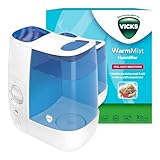
| Vicks Warm Mist VH845 | Warm mist, boils the water | 3.8 litres | £43.21 | Not stated | Not stated | Cannot be worked out | Cannot be worked out |
| Provirtec MistFree | Evaporative, no visible mist | 3 litres | £79.99 | 12W | 330ml/h | 1.0p | 3.8p |
The six worth looking at
TempPro TP50 Digital Thermo-Hygrometer
£8.49 buys you the number that none of the humidifiers on this page can tell you and none of the listings will print: what the relative humidity in your room is right now. It carries a best seller badge in its own category, runs on a battery so it costs nothing to keep running, and sits on a shelf or sticks to a wall. Buy this first, read it for a week in the room that bothers you, and the decision about the other five makes itself. If the reading sits high through a cold snap, you want a dehumidifier instead, and you have saved yourself the price of the wrong machine.
The catch: cheap capacitive humidity sensors drift, and this listing states an accuracy figure for the sensor without stating how it was established or how long the calibration holds. Treat it as a good guide to whether the room is in the rough territory you want, not as a laboratory instrument. It also does not log, so you are reading it by eye.
Amazon Basics Humidifier for Bedroom, Top Fill, 3L
£26.96, and the only one under £30 whose listing gives you both halves of the arithmetic. It states 25 watts and a mist output of up to 244ml an hour on its highest setting, which is 2.7p of electricity for every litre of water it puts into the air, and 7.9p if you run it flat out for a twelve hour night. Over a hundred winter nights that is £7.90. The tank fills from the top, which is the feature that decides whether a humidifier gets used in February or goes in the cupboard, and the spec sheet gives a noise figure of 31dB.
The catch: 31dB is the loudest of the three ultrasonic units here, and it is an ultrasonic, so in a hard water area it will leave fine white mineral dust on dark surfaces near it. The listing also doubles as an essential oil diffuser, and oils in the tank are the fastest route to a unit that needs descaling. The coverage claim appears twice, as 26 square metres and as 280 square feet, which at least agree with each other.
Dreo Humidifier for Bedroom with Sensor, 3L
£33.38 and number 2 in the Amazon UK Humidifiers chart on 15 October 2026, which also put it at number 22 in the whole Heating, Cooling & Air Quality chart. The thing worth paying for here is the built in humidity sensor and readout, because it closes the loop the hygrometer above opens: the machine can see the room and stop. It states 29 watts and 250ml an hour, so 3.1p a litre and 9.2p for a twelve hour night, with a 26dB noise claim and a 360 degree nozzle.
The catch: the spec block on this UK listing reads "Voltage 120 Volts (AC)", which is the North American figure and cannot be right for a unit shipped with a UK plug. It also states its coverage only in square feet, 300 of them, with no metric equivalent anywhere. Neither error is dangerous but both tell you the listing was not written for this market, and at 29 watts it is the thirstiest of the ultrasonic units here per litre delivered.
Levoit Humidifier for Bedroom, 25dB Ultra Quiet, Top Fill
£33.99 for the quietest claim on the page at 25dB and the lowest stated power draw of the three ultrasonics at 17 watts. Output is 190ml an hour, which gives 2.4p a litre and 5.4p over a twelve hour night, so about £5.37 across a hundred nights. The tank is 2.5 litres with a top fill opening, there is a water filter sponge pre-installed, and Levoit quotes up to 25 hours of runtime, which only makes sense at a low setting given the tank size.
The catch: the smallest tank here, so if you want a full night plus a day you will be refilling. The listing gives no coverage area in any unit, so there is nothing to check its 2.5 litres against. The pre-installed sponge is a consumable that nobody in the listing tells you how often to change, and like the other ultrasonics it will mist out whatever minerals your tap water carries.
Vicks Warm Mist Humidifier VH845, 3.8 Litre Tank
£43.21 and the only one here that works by boiling the water, which is why Vicks can claim mist that is up to 99 per cent bacteria free and why it runs silently, with no fan and no ultrasonic plate. The tank is the biggest on the page at 3.8 litres, Vicks quotes 24 hours from one filling and rooms up to 37 square metres, there are two intensity settings, and it takes the VapoPad scented pads that sit at number 1 in the Humidifiers chart in their own right. If you want warmth in the output rather than a cold plume, this is the mechanism that gives it.
The catch: the listing states no wattage at all, which is the one number that matters most on a product whose whole method is heating water. Everything else here can be costed and this cannot. A boiling element is an order of magnitude more power than an ultrasonic plate, so the cost per litre is very likely the highest on this page, and we are not going to put a figure on it we have not read. There is also a hot element and a steam vent, which is a different safety conversation in a child's room.
Provirtec MistFree Evaporative Humidifier
£79.99 makes this the dearest machine here and the cheapest to run, which is the kind of inversion that only shows up once you divide watts by output. It states 12 watts and up to 330ml an hour, so every litre it puts into the air costs 1.0p, a twelve hour night is 3.8p, and a hundred nights is £3.79. It is evaporative rather than ultrasonic, which means a wick and a fan instead of a vibrating plate, no visible plume and, as the listing puts it, no white dust. Tap water is fine. On the stated numbers it also puts out more water per hour than any other pick while drawing the least power.
The catch: the wick is a consumable and the listing does not say what a replacement costs or how often it needs one, which can quietly undo the running cost advantage. It is three times the price of the Amazon Basics unit, so on electricity alone the payback runs into years. Its coverage is given only as 200 square feet, and this is another listing carrying a 120 volt spec. An evaporative unit also needs a fan, so "no visible mist" does not mean no noise.
What these cost to run, and the unit nobody uses
Every electricity figure on this page is worked out at 26.32p per kWh, the Ofgem price cap unit rate for a direct debit customer from 1 October to 31 December 2026, alongside a 54.83p daily standing charge you pay whether the humidifier is on or not. The figures update themselves when the cap moves, so what you see is the current rate rather than the rate on the day this was written.
A twelve hour night is the number people expect, and on these machines it is small: between 3.8p and 9.2p depending on which one you buy. Even the thirstiest costs less over a hundred winter nights than the standing charge costs in a fortnight. If you were hoping for a running cost scandal, there isn't one. These are small appliances and they draw small amounts of power.
The useful figure is different. A humidifier's job is to move water into the air, so the unit that tells you how well it does that job for the money is the cost of the electricity per litre of water it delivers. Divide the stated wattage by the stated output in millilitres an hour and you get the kWh needed for one litre, and from there the money. Six of the 20 listings we read state both numbers, and across those six the answer runs from 1.0p a litre to 3.1p a litre, a threefold spread. The cheapest per litre in that set is the evaporative unit at 12 watts and 330ml an hour. The dearest is a 29 watt ultrasonic at 250ml an hour. Both are in the six above, and they are the two ends of the page.
Two honest limits on that figure. Stated output is an "up to" figure at the highest setting, so a machine run quietly overnight will deliver less per hour and the cost per litre stays roughly the same only if the power falls in step, which no listing tells you. And consumables sit outside it: a wick, a filter sponge or a scented pad is a real cost per litre that nobody publishes, which is exactly why we have not added one.
What 20 humidifier listings actually say
On 15 October 2026 we read the first 20 unsponsored results for "humidifier" on amazon.co.uk, taking pages one and two in order and skipping the sponsored slots. For each one we looked only at the product title, the About this item bullets, the product description, the product details and technical specification tables, and the important information block. Here is the count.
- 0 of 20 state a target or recommended indoor relative humidity. Not one listing tells you the number you are aiming at.
- 11 of 20 state a wattage. The nine that do not include the warm mist unit whose whole method is boiling water. Stated figures run from 2W to 29W.
- 6 of 20 state a mist output in millilitres an hour, which is the other half of any running cost sum.
- Both numbers together appear on 6 of 20, so a cost per litre can only be worked out on under a third of the market's shop window.
- 10 of 20 state a coverage area. 2 of those give two figures that disagree: the same model in two colours claims "up to 17 m²" in its bullets and "Floor Area 325 Square Feet" in its specs, and 325 square feet is 30 m².
- 4 of 20 carry a "120 Volts" spec on a UK listing.
- 3 of 20 mention a cleaning interval of any kind, despite the legionella point above.
- 3 of the 20 results are not humidifiers. Two are essential oil diffusers and one is a pack of disposable dehumidifier sachets that the search returned anyway.
- One listing states "Wattage 2 watts" and a floor area of "0.1 Square Feet", which is a tenth of a square foot, so at least one spec block on page one is unread by anyone.
The same shape shows up one level higher. The number 1 best seller in Amazon UK's Humidifiers category on 15 October 2026 was not a humidifier. It was Vicks VapoPads, a pack of scented pads that goes inside one.
Questions people ask
What humidity should a UK home be at in winter?
We looked for an official UK number and did not find one. The government guidance for rented housing providers on damp and mould, published 7 September 2023 and updated 1 April 2026, refers to high relative humidity, to humidity controlled fans and to monitoring with sensors, and prints no percentage. None of the 20 listings we read prints one either. What we can tell you is the direction of the risk the law takes seriously: damp and mould, with statutory investigation deadlines in England's social rented sector since 27 October 2025, and nothing at all on the dry side. If your hygrometer reading is high, that is the problem worth acting on.
Is a humidifier or a dehumidifier the one I need?
Buy the £8.49 hygrometer and read it for a week before you decide. On the chart evidence most British households in October are buying the dehumidifier, by seventeen to one in the top thirty of the relevant category. A dry throat on the first cold morning of the year is not by itself proof that the air in the house is dry, because warm dry-feeling air and genuinely low relative humidity are different things and only the meter can tell them apart.
Does the white dust from an ultrasonic humidifier matter?
It is the minerals in your tap water, aerosolised by the vibrating plate and then settled on nearby surfaces. In a hard water area you will see it on dark furniture within days. The evaporative unit on this page avoids it by design, because a wick leaves the minerals behind in the water, and that is the clearest practical difference between the two mechanisms. No listing we read quantified it.
How much does it cost to run one overnight?
On the four picks here that state a wattage, a twelve hour night costs between 3.8p and 9.2p at the current capped electricity rate. Across a hundred winter nights the same four span £3.79 to £9.16. The warm mist unit cannot be costed because its listing states no wattage.
Why is the dearest one the cheapest to run?
Because evaporation does the work instead of electricity. An ultrasonic plate has to shake water into droplets, which takes power in proportion to how much mist you want. An evaporative unit blows room air through a wet wick, so most of the energy comes from the air itself and the fan only has to move it. On the stated figures that is 12 watts for 330ml an hour against 29 watts for 250ml. The purchase price still dominates for years, so this is a reason to prefer the mechanism, not a reason to expect your money back.
Sources
- GOV.UK, Understanding and addressing the health risks of damp and mould in the home, published 7 September 2023, last updated 1 April 2026
- GOV.UK, Awaab's Law: guidance for social landlords, timeframes for repairs in the social rented sector, published 17 October 2025, last updated 16 July 2026
- Health and Safety Executive, Other systems that can create a risk of legionella, updated 26 September 2024
- Ofgem, Energy price cap unit rates and standing charges, 1 October to 31 December 2026
- Amazon.co.uk Best Sellers in Heating, Cooling & Air Quality, read 15 October 2026
- Amazon.co.uk Best Sellers in Humidifiers, read 15 October 2026
- Look Into, UK Running Cost Index, the rates engine behind every figure on this page
Prices and specifications were read on amazon.co.uk on 15 October 2026 and will have moved since. Look Into is a participant in the Amazon EU Associates Programme and earns from qualifying purchases made through the links above, at no cost to you. Look Into has not handled these products: every figure comes from the maker, the listing or a named source, read on the date shown.