
Short answer
A carer paid the National Living Wage of £12.71 an hour can work 16 hours a week and keep Carer's Allowance in 2026-27. That pays £203.36, under the £204 earnings limit.
The 17th hour costs them. Pay rises by £12.71 but the whole £86.45 allowance stops, so take-home falls by £64.12 a week. They would need to work 24 hours to be better off than at 16. We call hours 17 to 23 the carer's hour gap.
Prices and specs last checked by Look Into on 9 November 2026 · how we picked
What we found
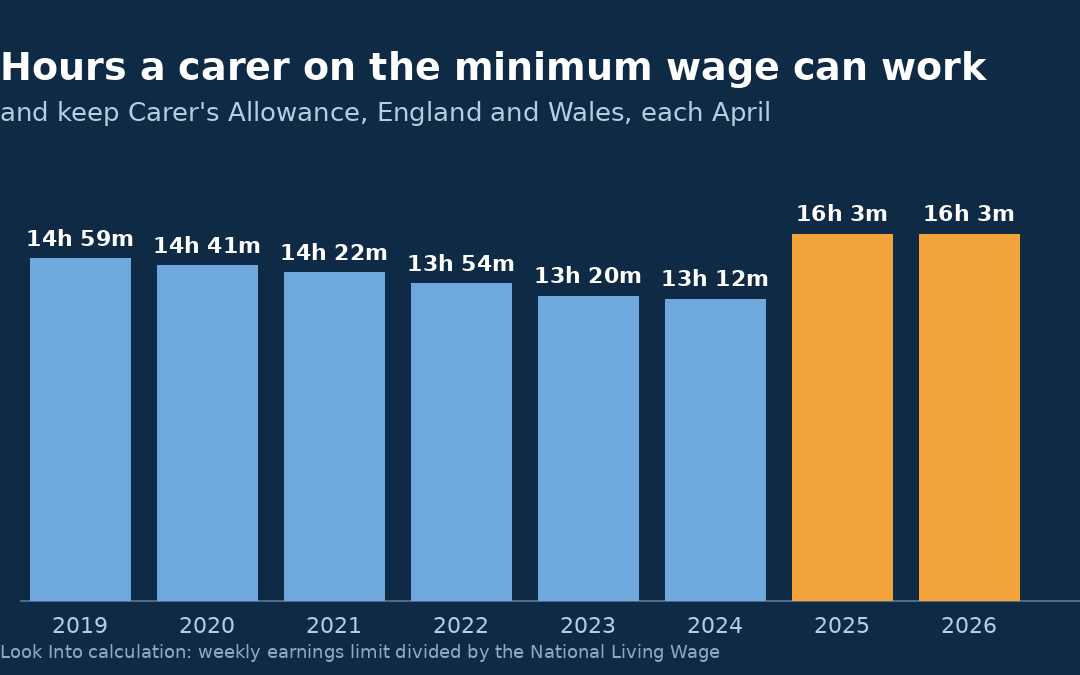
- The earnings limit buys 16 hours 3 minutes of work at the National Living Wage in 2026-27, up from 13 hours 12 minutes in 2024-25.
- Between April 2019 and April 2024 the hours fell every year, from 14 hours 59 minutes to 13 hours 12 minutes, because the minimum wage rose faster than the limit.
- At 16 hours a carer takes home about £280.19 a week including Carer's Allowance, after tax. At 17 hours it is £216.07.
- Working 23 hours a week takes home £278.16, still less than 16 hours. It takes 24 hours to come out ahead.
- The government is weighing an earnings taper. Its response to the call for evidence is due in the new year.
Carer's Allowance pays £86.45 a week to people in England and Wales who care for someone for at least 35 hours a week. You can work as well, but only while your earnings stay at or under £204 a week after tax, National Insurance and allowed expenses. Go a penny over and the whole payment stops for that week. This page works out what that means in hours for someone on the minimum wage, and where extra work stops paying.
How many hours the limit buys, 2019 to 2026
| From | National Living Wage, per hour | Earnings limit, per week | Hours of work the limit allows |
|---|---|---|---|
| April 2019 | £8.21 | £123 | 14 hours 59 minutes |
| April 2020 | £8.72 | £128 | 14 hours 41 minutes |
| April 2021 | £8.91 | £128 | 14 hours 22 minutes |
| April 2022 | £9.50 | £132 | 13 hours 54 minutes |
| April 2023 | £10.42 | £139 | 13 hours 20 minutes |
| April 2024 | £11.44 | £151 | 13 hours 12 minutes |
| April 2025 | £12.21 | £196 | 16 hours 3 minutes |
| April 2026 | £12.71 | £204 | 16 hours 3 minutes |
| April 2027 (if the 16-hour link holds) | £13.21 | £211.36 (not yet announced) | 16 hours 0 minutes |
For five years the limit lagged behind the minimum wage. Each April the wage went up by more than the limit, so a carer on the minimum wage had to cut their hours to keep the allowance. In April 2025 the limit jumped from £151 to £196, and the government linked it to 16 times the National Living Wage so that it rises with the wage. It went up again to £204 in April 2026.
The cliff edge, hour by hour
The table below shows weekly take-home pay for a carer paid £12.71 an hour in 2026-27, with Carer's Allowance where their pay is within the limit. It includes income tax and employee National Insurance at 2026-27 rates, and assumes no other income and no deductions from pay.
| Hours a week | Pay | Carer's Allowance | Income tax | National Insurance | Take-home |
|---|---|---|---|---|---|
| 12 | £152.52 | £86.45 | £0.00 | £0.00 | £238.97 |
| 13 | £165.23 | £86.45 | £1.99 | £0.00 | £249.69 |
| 14 | £177.94 | £86.45 | £4.53 | £0.00 | £259.86 |
| 15 | £190.65 | £86.45 | £7.07 | £0.00 | £270.03 |
| 16 | £203.36 | £86.45 | £9.62 | £0.00 | £280.19 |
| 17 | £216.07 | None | £0.00 | £0.00 | £216.07 |
| 18 | £228.78 | None | £0.00 | £0.00 | £228.78 |
| 19 | £241.49 | None | £0.00 | £0.00 | £241.49 |
| 20 | £254.20 | None | £2.49 | £1.00 | £250.71 |
| 21 | £266.91 | None | £5.04 | £2.01 | £259.86 |
| 22 | £279.62 | None | £7.58 | £3.03 | £269.01 |
| 23 | £292.33 | None | £10.12 | £4.05 | £278.16 |
| 24 | £305.04 | None | £12.66 | £5.06 | £287.31 |
| 25 | £317.75 | None | £15.20 | £6.08 | £296.46 |
| 26 | £330.46 | None | £17.75 | £7.10 | £305.62 |
The carer's hour gap
We use the term carer's hour gap for the hours of extra work that leave a carer with less money than they had at the limit. In 2026-27, for a carer on £12.71 an hour, it runs from the 17th hour to the 23rd. Take-home at 16 hours is £280.19 a week. Without the allowance, pay has to reach 23.23 hours before it matches that, so a 24th hour is the first that leaves them better off.
Put another way, a carer who moves from 16 hours to 23 hours works seven more hours a week and takes home £2.03 less. Over a year, the first extra hour alone costs £3,334.24 in take-home pay, because it gives up £4,495.40 of Carer's Allowance.
If you ignore tax and look only at gross pay, the drop at the 17th hour is £73.74 a week: £12.71 more pay, £86.45 less allowance. Tax narrows the gap a little, because Carer's Allowance is taxable and part of it is taxed at 16 hours.
Ways carers stay under the limit
The £204 is measured after certain deductions, not on gross pay. GOV.UK lists what counts.
- Half of any pension contributions. A carer working 17 hours earns £216.07; paying £24.14 a week into a pension would bring their counted earnings to £204.00.
- Care costs while you work. If you pay someone other than a close relative to look after the person you care for, or your children, while you are at work, up to half of your earnings can count as an expense.
- Work expenses your employer does not pay, such as equipment or travel between workplaces.
- Tax and National Insurance taken from your pay. Anyone who has these deducted can earn a little more gross before reaching £204.
These are general rules, not advice for your case. The Carer's Allowance Unit and Carers UK can check your figures, and Carers UK's guide to the earnings limit has worked examples.
What may change
In July 2026 the Department for Work and Pensions ran a six-week call for evidence on modernising Carer's Allowance, including whether to bring in an earnings taper so the payment reduces gradually instead of stopping. The summary of findings, published on 29 October 2026, reports 3,805 individual responses and 55 from organisations. Of 3,612 substantive answers on a taper, 40.3% preferred allowing more earnings before reductions start, followed by a faster reduction, and 26.2% preferred reductions starting lower but more gradually. The department says it proposes to publish its response in the new year.
Until then the cliff edge stays. The limit is due to follow the National Living Wage, which rises to £13.21 an hour in April 2027. Sixteen hours at that rate is £211.36, but the April 2027 limit had not been announced when we checked.
How we worked it out
| Item | What we did |
|---|---|
| Hours series | Weekly earnings limit divided by the National Living Wage for each April. Limits for 2019 to 2023 from Carers UK's table based on DWP rates, £139 and £151 from a DWP minister's letter deposited in Parliament, £151 to £196 from GOV.UK, £204 from GOV.UK eligibility guidance. Wage rates from GOV.UK. |
| Take-home pay | £12.71 an hour for 52 weeks. Carer's Allowance £86.45 a week where weekly pay is £204 or less. Income tax at 20% above the £12,570 personal allowance on pay plus Carer's Allowance. Employee National Insurance at 8% on pay above £12,570 a year. Annual figures divided by 52. |
| Assumptions | No other income, no pension contributions or expenses, steady weekly hours, England and Wales tax rules. Real payslips spread tax differently through the year. |
| Carer's hour gap | The hours above the limit where take-home is lower than at 16 hours. 2026-27: 17 to 23 hours. |
What this page could not check
- Universal Credit. Many carers also get it, and its own taper changes the sums. We have not modelled it.
- Scotland. Carer Support Payment has replaced Carer's Allowance there, and Scottish income tax bands differ.
- Your own deductions. Pension contributions and paid care costs both move the point where your limit falls.
- The official written answer listing every earnings limit since 1976 could not be opened from here, so the series starts in 2019.
Common questions
How many hours can I work on Carer's Allowance in 2026?
At the National Living Wage of £12.71 an hour, 16 hours a week. That pays £203.36, just under the £204 earnings limit. The limit is tested on earnings after tax, National Insurance and allowed expenses, so the exact hours depend on your pay and deductions.
What happens if I earn £1 over the Carer's Allowance earnings limit?
You lose the whole £86.45 for that week. There is no taper. For a carer on the National Living Wage, working a 17th hour adds £12.71 of pay but removes £86.45 of Carer's Allowance.
How many hours do I need to work to be better off than 16 hours?
24 hours a week, on our working. At 16 hours with Carer's Allowance a carer on £12.71 an hour takes home about £280.19 a week after tax. Without Carer's Allowance they need 23.23 hours of work to match that, so 24 whole hours to beat it.
Can pension contributions keep me under the Carer's Allowance earnings limit?
Yes, partly. Half of what you pay into a pension is taken off your earnings for the test. A carer working 17 hours (£216.07) would need to pay £24.14 a week into a pension to bring their counted earnings back to £204.
Will the Carer's Allowance earnings limit go up in April 2027?
The government has said the limit is pegged to 16 hours at the National Living Wage, which rises to £13.21 in April 2027. If that link holds, the limit would be £211.36. The April 2027 figure had not been announced when we checked on 9 November 2026.
Is the government getting rid of the Carer's Allowance cliff edge?
It is considering it. A call for evidence in summer 2026 asked whether to bring in an earnings taper. The summary of findings, published on 29 October 2026, says the government plans to publish its response in the new year.
Related
- Mobility and independent living
- How to help an elderly parent stay at home
- How to pay for care in the UK
- Disabled Facilities Grant funding per disabled resident
Sources
- GOV.UK, Carer's Allowance and eligibility (read 9 November 2026)
- GOV.UK, National Minimum Wage and National Living Wage rates
- GOV.UK, rates and thresholds for employers 2026 to 2027
- Carers UK, earnings limit rises to £204 and the 16-hour link (7 April 2026)
- Carers UK, earnings threshold and National Living Wage table (7 December 2022)
- DWP letter from Viscount Younger of Leckie, deposited in Parliament (19 December 2023)
- GOV.UK, Carer's Allowance increased earnings limit evaluation (29 October 2026)
- GOV.UK, views sought to transform benefit paid to carers (7 July 2026)
- GOV.UK, Carer's Allowance call for evidence: summary of findings (29 October 2026)
This page has no affiliate links or sponsored content. You are free to cite the figures with a link to this page.
 Home LiftsHome lift spec sheets compared: what four UK makers publish, and what they leave out
 Home LiftsHome Lift Deposits and Cancellation: What Sellers' Own Terms Say
 StairliftsCan You Cancel a Stairlift Order? What Four Sellers' Terms Say About Curved Stairlifts
 MobilityThe £30,000 Disabled Facilities Grant Cap Is Worth £17,613 in 2008 Money