

Key takeaways
- We read 113 heated gilet listings on Amazon UK on 30 September 2026. 71 promise a run time in hours, but only 3 give a power figure in watts, so for 110 of the 113 there is nothing on the page to check the run time against. We call that the missing watt.
- A USB gilet on a 5V 2A supply draws at most 10W. At the Ofgem cap rate of 26.32p a kWh from 1 October 2026, that is about a third of a penny an hour, and about 1p to refill a 10,000mAh power bank.
- A 2kW fan heater costs 52.6p an hour at the same rate. A gilet only warms you, not the room, but if you are the only one in, that is the gap.
- 45 of the 113 listings mention a 7.4V supply, and 27 of those never mention 5V. A 7.4V gilet is built around its own battery pack, so do not assume the power bank in your drawer will run it at full heat.
Heated gilets have stopped being a niche bit of kit for motorcyclists and ice fishermen. Search Amazon UK for one on 30 September 2026 and you get page after page of them, nearly all from brands you will not have heard of, nearly all promising hours of warmth from a power bank in the pocket. With the energy price cap going up on 1 October, the pitch writes itself: heat yourself, not the house.
The pitch is mostly right, and we can show the sums. What the listings will not show you is the one number you need to check any of it. We read 113 of them on the day and counted what each one actually tells you. Then we picked six that do different jobs, and did the arithmetic the listings leave out.
Prices in this table come from Amazon and are refreshed at least once a day, with the date of the last update under the table. The cost-per-use and running-cost figures on this page use prices Look Into read on 30 September 2026, so they can differ from today's price.


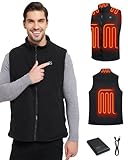
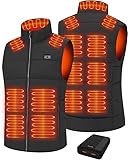
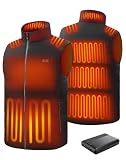


As an Amazon Associate, Look Into earns from qualifying purchases. Product prices and availability are accurate as of 22 October 2026 and are subject to change.
Prices and specs last checked by Look Into on 30 September 2026 · next check 11 November 2026 · how we picked
The missing watt: what 113 listings do not tell you
A heated gilet is a small electric heater stitched into a waistcoat. How warm it gets and how long its battery lasts both come down to one figure: how many watts the heating panels draw. Battery capacity divided by power gives you run time. Power multiplied by the unit rate gives you running cost. Without the watts, neither sum can be done.
So we went looking for it. On 30 September 2026 we ran four searches on Amazon UK (heated gilet, USB heated gilet, and the men's and women's versions), took the first two pages of each, and kept every listing for a heated gilet, vest or body warmer. That came to 113, once standalone battery packs were taken out. For every one we read the title, bullet points, product facts and description, then searched the whole product page for a power figure.
71 of the 113 promise a run time in hours. Three state a power figure in watts, and all three say the same thing in the same words: a maximum of 14W from the 7.4V port. That leaves 110 listings with no watts anywhere on the page. We call that gap the missing watt: a run time, a temperature or a warmth claim, with nothing on the page to check it against.
| What the listing states | Listings | Out of |
|---|---|---|
| A run time in hours | 71 | 113 |
| A power figure in watts, anywhere on the product page | 3 | 113 |
| Battery energy in watt-hours | 3 | 113 |
| A USB current such as 5V 2A, from which the power follows | 25 | 113 |
| A battery or power bank in the box | 68 | 113 |
| Battery or power bank not included | 30 | 113 |
| A 7.4V supply | 45 | 113 |
| A 7.4V supply and no mention of 5V | 27 | 113 |
| A heating temperature | 62 | 113 |
| A top setting of 60°C or more | 48 | 113 |
| CE marking | 36 | 113 |
| UKCA marking | 0 | 113 |
There is a partial way round it. 25 listings state the USB current they need, usually 5V 2A, and volts times amps is watts: 5V at 2A is 10W. That is a ceiling, not a measurement, because the gilet may draw less on its lower settings. But it is enough to sanity-check a claim, and it is the most useful line to look for on any USB gilet listing.
Battery energy has the same problem in a different unit. Listings quote milliamp-hours, because 10,000mAh sounds like more than 37Wh. The two are the same thing: a power bank's mAh figure is quoted at the cell's nominal 3.7V, so multiply by 3.7 and divide by 1,000 to get watt-hours. The XINSONYUELL listing does exactly that sum for you, 16,000mAh and 59.2Wh, which is how you know the convention holds.
What it costs to run, at the October 2026 cap
From 1 October to 31 December 2026 the Ofgem cap sets electricity at 26.32p a kWh on average for direct debit customers, with a 54.83p daily standing charge. Ofgem also notes the rate carries no VAT from 1 October 2026 to 31 March 2027. Everything below is arithmetic at that rate, not a measurement.
A USB gilet at the full 10W of a 5V 2A supply uses 0.01kWh an hour, which is 0.26p. Charging a power bank is not perfectly efficient, so allow about 15 per cent for losses on the way in, which is our assumption, not a figure from any maker. That puts the true cost at about 0.3p an hour on high.
Put it the other way round. A 10,000mAh bank holds about 37Wh, so refilling it from the wall takes roughly 43.5Wh and costs about 1.1p. A 20,000mAh bank costs about 2.3p to fill. The 59.2Wh battery in the XINSONYUELL kit costs about 1.8p.
A 2kW fan heater at the same rate costs 52.6p an hour. Four hours of it on a cold evening is £2.11. Four hours of a gilet on high is about 1.2p. That is a fair comparison only if you are the only person in the room and you are happy to sit in a cold room in a warm waistcoat, which is the same trade-off as an electric blanket. We ran those numbers in electric blanket vs heater, and our appliance running cost calculator will do the sum for any wattage you like.
Two other cheap ways to stay warm without heating the room: our guide to rechargeable hand warmers found the same missing watt on 100 listings, and our thermal curtains guide works out what heavy curtains save per window.
Checking the run-time claims
Where a listing gives both a battery size and a run time, you can divide one by the other and see what power it is claiming. Three of our six give enough to do it.
The Techstuph kit claims five to six hours on high from 20,000mAh. That is 74Wh at the cell. After roughly 15 per cent conversion loss on the way out to 5V, about 63Wh reaches the gilet, and if the gilet draws the full 10W of a 5V 2A supply, that lasts about six and a quarter hours. Five to six hours on high is consistent with that.
The XINSONYUELL kit claims four hours on high from 59.2Wh, which is at most 14.8W, and ten hours on low, which is about 5.9W. The high figure is above the 10W a 5V 2A USB port can supply. That is not a fault in the listing. It is the reason 7.4V gilets exist: a dedicated pack can push more power into the panels than a phone power bank can.
The WUEAOA kit claims up to eight hours from 10,000mAh without saying on which setting. 37Wh over eight hours is about 4.6W at the cell, and less after losses. That fits a low setting and does not fit a high one, so read it as the low-setting figure.
Which rules cover a heated gilet
The Electrical Equipment (Safety) Regulations 2016 apply to equipment designed for use at between 50 and 1,000V AC or between 75 and 1,500V DC. A 5V or 7.4V gilet sits well below that floor, so those regulations do not reach it. What does apply is the general duty in the General Product Safety Regulations 2005, which says a producer shall not place a product on the market unless it is a safe product.
None of the 113 listings we read mentions UKCA marking, and 36 mention CE. We are not saying any of these gilets should carry a particular mark, and none of this is an accusation against a product on this page. The point is narrower: for most buyers the Amazon listing is the only safety information they will see before the thing arrives, and most listings say very little. One of our six, the XINSONYUELL, names the IEC 62133 standard for its battery. That is the kind of line worth looking for.
How we picked these
We took the 113 listings from the audit above, removed anything we could not price or add to a basket on 30 September 2026, and read the Amazon UK best sellers rank on each product page. We chose six that do genuinely different jobs, from a bare gilet for your own power bank to a fully specified 7.4V kit, rather than six versions of the same waistcoat. Prices are the buy box price on the day. Temperatures, run times and battery sizes are as each listing states them. Running costs are our arithmetic at the October 2026 cap rate. We do not test.
| Gilet | Best for | Battery in the box | Supply stated | Run time stated, hours | Top setting |
|---|---|---|---|---|---|
| vapesoon 26-pad | Own-power-bank buyers | Not included | 5V 2A or 7.4V | Not stated | 65°C |
| Vanvanjek women's 15-pad | Women, own power bank | Not included | 5V 2A | Not stated | 60°C |
| WUEAOA 6-panel | Lowest price with a battery | 10,000mAh | Not stated | Up to 8, setting not stated | 55°C |
| CKARTIC 15-zone | Rain and wind | 10,000mAh | Not stated | Not stated | 65°C |
| Techstuph 15-zone | All-day wear | 20,000mAh | 5V USB | 5 to 6 on high, 11 to 12 on low | 60°C |
| XINSONYUELL women's | Warmest, fully specified | 16,000mAh, 59.2Wh | 7.4V | 4 on high, 10 on low | 65°C |
The six we would buy
vapesoon 26-pad heated gilet, battery not included
Live price on Amazon · number 15 in Men's Outerwear Gilets (chart read 30 September 2026)
One of the few gilets in our sample that takes either kind of supply. The listing says it works with a 5V 2A power bank through the USB lead or a 7.4V DC battery pack through the round plug, and it splits the heat into four zones you can switch separately. It is sold without a battery, which is why it is cheap: if you already have a decent power bank, this is the least you can spend on a gilet with that many heating pads.
The catch: the listing states 65°C, 55°C and 45°C settings but no run time and no power figure for the USB side. On a 5V 2A bank it cannot draw more than 10W, so expect it to run cooler on USB than on a 7.4V pack.
Vanvanjek women's 15-pad heated gilet, battery not included
Live price on Amazon · number 1 in Women's Hiking and Outdoor Recreation Vests (chart read 30 September 2026)
Number one in Amazon's women's hiking vests chart on the day, and a model of what a listing should tell you. It names the supply it needs, a 5V 2A power bank of at least 10,000mAh, and it gives the three settings in degrees: 40°C, 50°C and 60°C. Because the current is stated, the power follows: 5V at 2A is 10W at most, which is enough to work out running cost and battery life yourself. There is a heated collar as well as back and front panels.
The catch: no run time is stated, so the battery-life sums below are ours, not the seller's. And "minimum 10,000mAh" is a floor, not a recommendation: on high that is roughly three hours.
WUEAOA 6-panel heated gilet with 10,000mAh power bank
Live price on Amazon · number 53 in Men's Hiking and Outdoor Recreation Vests (chart read 30 September 2026)
The cheapest of our six, and it still comes with a power bank in the box. Six carbon fibre panels (two shoulders, back, neck and two across the front) and three settings of 39°C, 45°C and 55°C, which is a gentler top end than most. The listing claims up to eight hours from the 10,000mAh bank. It does not say on which setting, but eight hours only adds up on low: it implies a draw of under 5W.
The catch: six panels is fewer than the 15-zone gilets further up the price range. Treat it as a way to find out whether you like heated clothing before spending more.
CKARTIC 15-zone heated gilet with 10,000mAh power bank
Live price on Amazon · number 13 in Men's Outerwear Gilets (chart read 30 September 2026)
Most heated gilets are a thin shell over the heating panels and expect a coat on top. This one is built to be the outer layer: the listing describes a windproof, water-resistant outer, the carbon fibre heating layer, then insulating padding inside, sized S to 3XL. The settings are given as ranges, 55 to 65°C on high and 45 to 55°C on medium, and the power bank in the box is described as UL and CE certified.
The catch: this is the missing watt in its purest form. The listing gives no run time, no voltage and no current, so there is no way to work out how long the 10,000mAh bank lasts or what the gilet draws. We could not check the certification claim either.
Techstuph 15-zone heated gilet with 20,000mAh power bank
Live price on Amazon
Double the battery of most kits, and a run-time claim that survives the arithmetic. The listing gives five to six hours on high, seven to eight on medium and 11 to 12 on low from a 20,000mAh bank, and describes the bank as compatible with 5V 2A USB devices, so it is a standard USB bank. 20,000mAh at a nominal 3.7V is 74Wh. If the gilet draws the full 10W a 5V 2A port allows, conversion losses included, that is a little over six hours, so five to six on high is believable. The settings are 40°C, 50°C and 60°C.
The catch: the care label on the listing says hand wash only, where most of the others say machine wash. A 20,000mAh bank is also heavier and bulkier in the pocket than a 10,000mAh one.
XINSONYUELL women's heated gilet with 16,000mAh 7.4V battery
Live price on Amazon · number 4 in Women's Hiking and Outdoor Recreation Vests (chart read 30 September 2026)
One of only three listings in our sample that gives the battery in watt-hours, 59.2Wh, alongside run times for every setting: ten hours on low, six on medium and four on high. That is everything you need to check it, and it checks out: 59.2Wh over four hours is up to 14.8W on high. That is more than a 5V 2A USB port can supply, which is the practical reason 7.4V gilets run hotter. All 15 zones switch on and off separately, the settings are 45°C, 55°C and 65°C, and the listing names the IEC 62133 battery safety standard.
The catch: it is a 7.4V system. The battery in the box drives it; an ordinary USB power bank will not run it at full heat. It is also the dearest of the six.
Questions people ask
Can I use any power bank with a USB heated gilet?
Only if it is a 5V gilet and the bank can supply the current the gilet asks for, which is usually 5V at 2A. Several listings also set a minimum capacity of 10,000mAh. A 7.4V gilet is built to run from its own battery pack, and 27 of the 113 listings we read mention 7.4V without mentioning 5V at all, so check the plug and the stated voltage before you buy a gilet on the assumption that your existing bank will run it.
How much does it cost to run a heated gilet?
Very little. A USB gilet on a 5V 2A supply draws at most 10W. At the Ofgem cap rate of 26.32p a kWh from 1 October 2026, and allowing about 15 per cent for charging losses, that is about 0.3p an hour. Refilling a 10,000mAh power bank costs about 1.1p, and a 20,000mAh bank about 2.3p.
How long does a heated gilet battery last?
It depends on the power the gilet draws, which 110 of the 113 listings we read do not state. As a guide, a 10,000mAh bank holds about 37Wh, and after conversion losses delivers roughly 31Wh, which is about three hours at the 10W a 5V 2A gilet can draw on high. Low settings roughly double that or more. Where a listing gives battery capacity and run time for each setting, you can divide one by the other to see what it is claiming.
What is the difference between 5V and 7.4V heated gilets?
A 5V gilet runs from a standard USB power bank, and a 5V 2A port tops out at 10W. A 7.4V gilet runs from a dedicated battery pack and can draw more: one listing we read gives 59.2Wh and four hours on high, which works out at up to 14.8W. More power means more heat on the top setting, at the cost of needing the maker's own battery.
Can you wash a heated gilet?
Most listings say the gilet is machine washable. Where they give instructions, they say to take the battery out and zip the pockets first, and one suggests a laundry bag. Not all of them: the Techstuph listing says hand wash only. Go by the care label on the one you buy, and never wash it with the power bank or cable still attached.
Is a heated gilet cheaper than heating the room?
Per hour, by a long way. A gilet on 10W costs about 0.3p an hour at the October 2026 cap rate, against 52.6p an hour for a 2kW fan heater. But the gilet warms one person and nothing else, so the comparison only holds if you are the only one in the room and you are happy for the room itself to stay cold.
Sources
- Ofgem, Changes to energy price cap between 1 October and 31 December 2026. ofgem.gov.uk, read 30 September 2026.
- The Electrical Equipment (Safety) Regulations 2016, regulation 3. legislation.gov.uk, read 30 September 2026.
- The General Product Safety Regulations 2005, regulation 5. legislation.gov.uk, read 30 September 2026.
- Amazon UK product pages for all 113 heated gilet listings in the audit, read 30 September 2026.
Prices were read on amazon.co.uk on 30 September 2026 and change often, so treat them as a guide and check before you buy. The comparison table near the top pulls live prices from Amazon's product feed, which can sit slightly off the price in the buy box. Look Into is a Whito Ltd publication. We earn a commission on some links to Amazon at no cost to you, and commission never changes what we recommend or the order we list it in.