
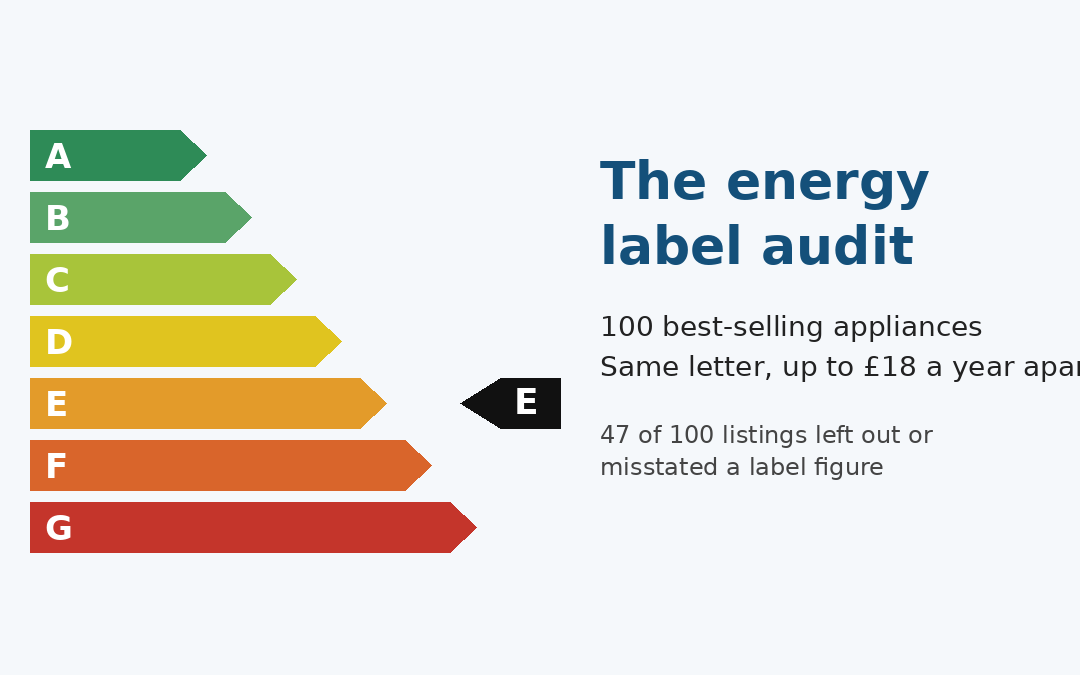
We read the energy label of every one of AO's 20 best-selling fridge freezers, washing machines, dishwashers, freezers and TVs: 100 appliances, checked on 8 and 9 November 2026 and costed at the October 2026 price cap of 26.32p per kWh. The short version is that the letter is a weak guide to the bill, and the number underneath it is a strong one.
How weak depends on what you are buying. Every best-selling washing machine is now an A, so the letter separates nothing. Dishwashers still run from A to E, and there the letter does line up with cost. In between, models with the same letter can differ by £18 a year. We call that the label-letter gap.
What 100 labels showed
- Grades across the 100: 22 A, 5 B, 4 C, 4 D, 54 E and 11 F. All 22 A grades are washing machines and dishwashers.
- The label-letter gap: E-rated fridge freezers use 189 to 257.6 kWh a year, £18.06 apart. A-rated washing machines use 33 to 51 kWh per 100 cycles.
- Biggest running-cost spread: dishwashers, £37.64 to £64.33 a year at five cycles a week.
- 47 of the 100 AO listings left out, contradicted or mislabelled a figure from their own label. Without TVs, where AO never shows the figure, it was 27 of 80.
- Three listings showed the label for a different model code, and two showed a factory print drawing instead of the label.
Prices and specs last checked by Look Into on 9 November 2026 · next check 1 January 2027 · how we picked
The five audits
Ovens are audited separately, in oven running costs, because their labels still use the old A+++ to D scale. All 8 A+ best-sellers there use the same 0.69 kWh per fan cycle, at prices from £199 to £999.
| Category | Grades among the 20 | Label energy range | Running cost range | Gap a year |
|---|---|---|---|---|
| Fridge freezers | 18 E, 2 D | 184 to 257.6 kWh a year | £48.43 to £67.80 a year | £19.37 |
| Washing machines | 20 A | 33 to 51 kWh per 100 cycles | 8.69p to 13.42p a wash | £9.85 (4 washes a week) |
| Dishwashers | 2 A, 5 B, 4 C, 2 D, 7 E | 55 to 94 kWh per 100 cycles | 14.48p to 24.74p a cycle | £26.69 (5 cycles a week) |
| Freezers | 20 E | 156 to 250 kWh a year | £41.06 to £65.80 a year | £24.74, mostly size |
| TVs | 9 E, 11 F | 26 to 129 kWh per 1,000 hours (SDR) | 0.68p to 3.40p an hour | £6.53 at 55 inches (4 hours a day) |
The label-letter gap
An energy class is a band, not a measurement. Two appliances wearing the same letter can sit at opposite ends of it, and the bill follows the measurement.
- Fridge freezers: 18 of the 20 best-sellers are E rated, using 189 to 257.6 kWh a year. That is £49.74 to £67.80, a gap of £18.06 a year for the same letter.
- Washing machines: all 20 are A rated, using 33 to 51 kWh per 100 cycles. The thirstiest A uses 55% more than the most frugal.
- Dishwashers: the seven E-rated best-sellers use 76 to 94 kWh per 100 cycles, £12.32 a year apart at five cycles a week.
- TVs: at 55 inches, the E-rated Hisense E6S uses 60 kWh per 1,000 hours and the F-rated Samsung UE55U7000H 77. But the letter is set against screen area, so the 55-inch TCL V6D gets an E while using more than the 50-inch, which gets an F.
Size distorts the letter in the other direction too. A 61-litre under-counter freezer and a 297-litre chest freezer are both E rated, but the chest freezer costs £20.47 per 100 litres a year to run and the small one £67.31.
Where the letter does work
Dishwashers are the exception. The best-sellers still span five grades, and the grades track the bill: the two A-rated full-size models use 55 kWh per 100 cycles, the B-rated ones 64 to 65 and the E-rated full-size ones 92 to 94. The A-rated Hisense HS663A90BXUK was also £10 cheaper to buy than the E-rated Bosch SMS26AW08G. If you only check one label closely, make it the dishwasher's.
What the listings got wrong
The energy label is the one document the manufacturer is responsible for, and European Commission guidance on the label rules says the model on the label has to be the unit on sale. AO links the label from every product page. The trouble is everything around it.
| Category | Listings with a problem | What we found |
|---|---|---|
| Fridge freezers | 6 of 20 | 5 spec tables with no annual kWh. The Bosch KGN34NWEAG shows an old-scale A++ beside its E. |
| Washing machines | 8 of 20 | 2 show another model's label (Candy GD 28S6-80, Hotpoint NSWM 946 BS UK). Energy or water in the spec table contradicts the label on 2. One lists energy per 100 cycles as annual. 3 leave out water, one of them energy too. |
| Dishwashers | 5 of 20 | No energy per 100 cycles in 5 spec tables. 2 Comfee listings show a factory print drawing with production notes instead of the label. |
| Freezers | 8 of 20 | 6 spec tables with no annual kWh. 2 give a capacity that differs from the label. |
| TVs | 20 of 20 | No energy figure in any spec table. One lists energy per 1,000 hours as annual. One shows the label for a different model code. |
Outside AO, retailers disagreed with each other and with the maker. The Beko CFG4501 fridge freezer is 257.6 kWh a year on Beko's own page, 261 at Hughes and 268 at Marks Electrical. The details are on the fridge freezer audit.
How to use a label in a shop or online
- Open the label itself, not the spec table. It is the figure the maker answers for.
- Check the model code printed at the top of the label matches the one in the listing.
- Compare the kWh figure, not the letter, and compare like for like: kWh a year for fridges and freezers, per 100 cycles for washing machines and dishwashers, per 1,000 hours for TVs.
- Multiply by your tariff. At 26.32p, every 10 kWh a year is £2.63.
- For TVs, look at the HDR figure too. It is often double the headline one.
How we did it
| Item | What we did |
|---|---|
| Which models | For each category, AO's range sorted by "Most Popular", 60 per page, and the first 20 distinct models. Colour variants skipped; different TV screen sizes counted separately. |
| Energy figures | Read from the UK or EU energy label image on each AO product page. Where a label was missing or belonged to another model, from the maker's own page or product information sheet, as stated on each audit. |
| Rate | 26.32p per kWh, the Ofgem cap for 1 October to 31 December 2026. Standing charge excluded. |
| Usage | Washing machines 208 washes a year, dishwashers 260 cycles, TVs four hours a day. These are our illustrations. Fridges and freezers use the label's annual figure. |
| Rounding | Pence rounded once, at the end of each sum. |
What this audit could not check
- We have not used or measured any of these appliances. Every figure is from a label or a maker's page.
- Real use in your home, which depends on settings, programmes and where the appliance sits.
- Whether other retailers' listings have the same problems as AO's. AO was chosen because its best-seller ranking is public.
Common questions
Does the energy rating tell you how much an appliance costs to run?
Only roughly, and it depends on the appliance. In our check of 100 best-sellers, all 20 washing machines were A rated yet used 33 to 51 kWh per 100 cycles, and 18 fridge freezers rated E used 189 to 257.6 kWh a year. The kWh figure on the label is the number to compare.
What is the label-letter gap?
Our name for the difference in running cost between the most and least efficient models that carry the same energy class. Among AO's best-selling E-rated fridge freezers it is £18.06 a year at the October 2026 cap; among E-rated dishwashers it is £12.32 a year at five cycles a week.
Which appliances have the biggest running-cost differences?
Dishwashers, where the best-sellers run from A to E and the gap between the cheapest and dearest to run is £26.69 a year at five cycles a week. For washing machines the gap is £9.85 a year at four washes a week.
How many retailer listings get the energy figures wrong?
Of the 100 AO best-seller listings we checked, 47 left out, contradicted or mislabelled a figure from their own energy label. All 20 TV listings left the energy figure out of the spec table, so excluding TVs it was 27 of 80.
Where should I look for an appliance's energy use?
On the energy label itself, which every listing links to. Check the model code on the label matches the one you are buying, then compare the kWh figure.
Sources
- Ofgem, changes to the energy price cap between 1 October and 31 December 2026
- European Commission, energy label FAQ: can equivalent models appear on the same label?
- The five audits above, each with its own AO, maker and retailer sources.
 Solar PanelsPlug-in solar panels UK 2026: the rules, what they save and what 20 listings tell you
 Household SavingsRepair or replace calculator: washing machines, dryers, fridges and dishwashers
 Household SavingsThe 10 cheapest ways to heat one room this winter, ranked by cost per hour
 Household SavingsUK Heat Pump Install Price Tracker