
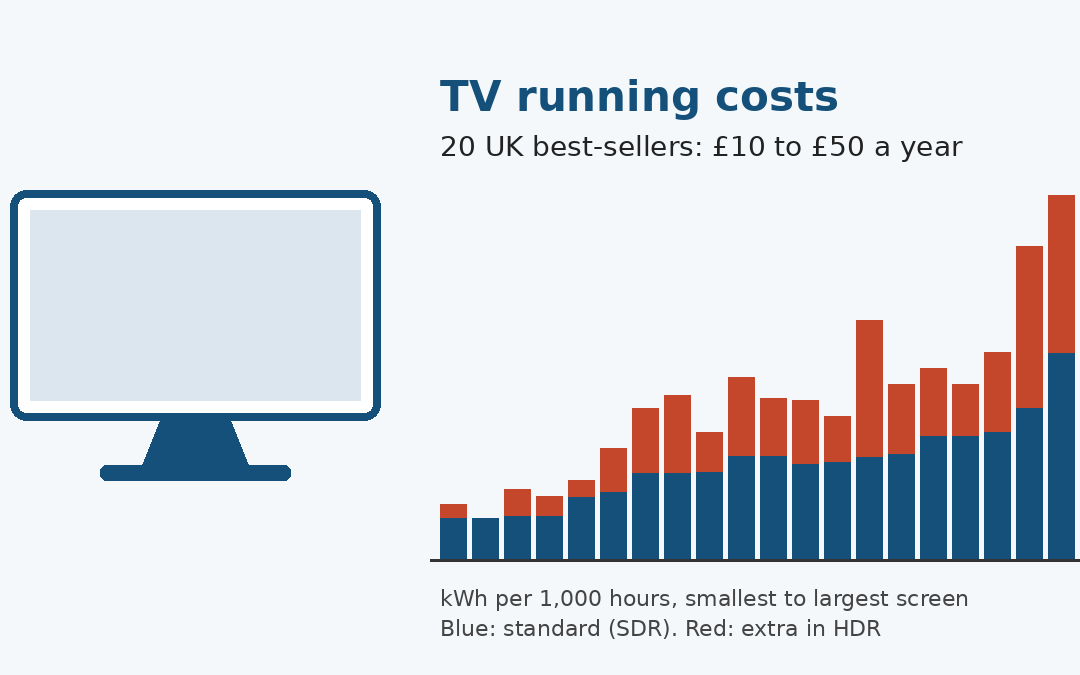
A best-selling TV costs 0.68p to 3.40p an hour to run in standard dynamic range at the October 2026 price cap of 26.32p per kWh. We read the energy label for each of the 20 most popular TVs on AO. At four hours a day, a 32-inch set costs about £10 a year and the 75-inch Samsung UE75U7000H £49.57.
Two things on the label are easy to misread. HDR, which most streaming and 4K content now uses, can more than double a TV's power, and nearly every best-seller is rated G for it. And because the letter is set against screen size, a bigger TV can earn a better grade while using more electricity.
What we found, 9 November 2026
- SDR running cost: 0.68p to 3.40p an hour, or £9.99 to £49.57 a year at four hours a day.
- No TV on AO is A rated. Of 287, 125 are E and 110 F. Among the 20 best-sellers, 9 are E and 11 F.
- HDR: 19 of the 20 are G rated for HDR. The Hisense ER8S 55-inch uses 64 kWh per 1,000 hours in SDR and 150 in HDR.
- At 55 inches, the best-sellers use 60 to 77 kWh per 1,000 hours in SDR. The two Samsungs use the most.
- AO's spec tables give no energy per 1,000 hours for any of the 20. One mislabels it as annual use, and one listing shows the label for a different model code.
Prices and specs last checked by Look Into on 9 November 2026 · next check 1 January 2027 · how we picked
All 20, by screen size
| Size | Model | AO price | Class (SDR) | SDR kWh/1,000h | HDR kWh/1,000h | Per hour (SDR) | A year, SDR | A year, all HDR |
|---|---|---|---|---|---|---|---|---|
| 32" | Philips PHS6050 32PHS6050/05 | £129 | E | 26 | 35 | 0.68p | £9.99 | £13.45 |
| 32" | Veltech HX630 VR32HX630 | £129 | E | 26 | 26 | 0.68p | £9.99 | £9.99 |
| 32" | Hisense E4S 32E4STUK | £179 | F | 27 | 40 | 0.71p | £10.38 | £15.37 |
| 32" | Samsung H5000F UE32H5000F | £149 | F | 27 | 44 | 0.71p | £10.38 | £16.91 |
| 40" | Hisense A4S 40A4STUK | £199 | F | 39 | 50 | 1.03p | £14.99 | £19.21 |
| 43" | Hisense E6S 43E6STUK | £249 | E | 42 | 70 | 1.11p | £16.14 | £26.90 |
| 50" | Hisense E6S 50E6STUK | £299 | E | 54 | 95 | 1.42p | £20.75 | £36.51 |
| 50" | TCL C6K 50C6K-UK | £399 | E | 54 | 103 | 1.42p | £20.75 | £39.58 |
| 50" | TCL V6D 50V6D-UK | £259 | F | 55 | 80 | 1.45p | £21.13 | £30.74 |
| 50" | Samsung UE50M70H | £349 | F | 65 | 101 | 1.71p | £24.98 | £38.81 |
| 50" | Samsung UE50U7000H | £289 | F | 65 | 114 | 1.71p | £24.98 | £43.81 |
| 55" | Hisense E6S 55E6STUK | £349 | E | 60 | 100 | 1.58p | £23.06 | £38.43 |
| 55" | TCL V6D 55V6D-UK | £329 | E | 61 | 90 | 1.61p | £23.44 | £34.58 |
| 55" | Hisense ER8S 55ER8STUK | £999 | E | 64 | 150 | 1.68p | £24.59 | £57.64 |
| 55" | TCL T6C 55T6C-UK | £329 | F | 66 | 110 | 1.74p | £25.36 | £42.27 |
| 55" | Samsung UE55M70H | £399 | F | 77 | 110 | 2.03p | £29.59 | £42.27 |
| 55" | Samsung UE55U7000H | £339 | F | 77 | 120 | 2.03p | £29.59 | £46.11 |
| 65" | Hisense E6S 65E6STUK | £459 | E | 80 | 130 | 2.11p | £30.74 | £49.96 |
| 65" | TCL C6K 65C6K-UK | £649 | F | 95 | 196 | 2.50p | £36.51 | £75.32 |
| 75" | Samsung UE75U7000H | £629 | F | 129 | 228 | 3.40p | £49.57 | £87.61 |
HDR is where the power goes
The energy class on a TV label is for standard dynamic range. Underneath is a second, smaller scale for HDR, and 19 of these 20 best-sellers are rated G on it. The Veltech HX630 is the exception, and it is a 32-inch HD set.
The gap between the two figures varies a lot. The TCL C6K 65-inch uses 95 kWh per 1,000 hours in SDR and 196 in HDR. The Hisense ER8S 55-inch goes from 64 to 150. If most of what you watch is 4K streaming in HDR, the right-hand cost column is closer to your bill than the left.
A bigger TV can get a better letter
TV classes are calculated against screen area, so the letter tells you how efficient a set is for its size, not how much it will cost you. The TCL V6D shows it neatly. The 50-inch is F rated and uses 55 kWh per 1,000 hours. The 55-inch is E rated and uses 61. The better letter comes with the higher bill.
Within one size, the kWh figure is the fair comparison. At 55 inches, the Hisense E6S uses 60 kWh per 1,000 hours and the Samsung UE55U7000H and UE55M70H use 77, so the Samsungs cost £6.53 a year more at four hours a day.
Listings that hide or misstate the figure
- AO's spec tables give no SDR or HDR energy figure for any of the 20 best-sellers. The only place to find it is the energy label image.
- Veltech HX630: AO's spec table lists "Annual Energy Consumption 26 kWh". The label figure is 26 kWh per 1,000 hours, not per year. At four hours a day it uses about 38 kWh a year.
- Hisense ER8S 55-inch (55ER8STUK): the label on AO's page is for the 55UR8STUK, a different model code in Hisense's RGB MiniLED range. We used its figures, 64 and 150 kWh per 1,000 hours, but they are not confirmed for the ER8S.
What the label leaves out
Label figures are measured in the TV's default picture mode. Turning brightness up, or using a vivid or dynamic mode, raises the power draw; eco and ambient light settings lower it. Standby power is not included in these figures.
Which to choose
- Pick the size first: it decides the running cost more than anything else. A 75-inch costs about five times as much to run as a 32-inch.
- Within a size, compare the kWh per 1,000 hours on the label, not the letter.
- If you watch a lot of HDR, look at the HDR figure. It can be more than twice the SDR one.
- Over five years at four hours a day, the difference between the cheapest and dearest 55-inch here is about £33. Picture quality and price will matter more for most people.
How we worked it out
| Item | What we did |
|---|---|
| Which models | AO's TV range, sorted by "Most Popular", 60 per page. The first 20 models. Different screen sizes in one range count as separate models, because each has its own label. |
| Energy | SDR and HDR kWh per 1,000 hours, read from the UK or EU energy label image on each AO product page. |
| Electricity rate | 26.32p per kWh, the Ofgem cap for 1 October to 31 December 2026, direct debit, Great Britain average. Standing charge excluded. |
| Viewing time | Four hours a day, 1,460 hours a year. This is our illustration. Scale it to your own viewing. |
| Prices | AO's non-member prices on 9 November 2026. Black Friday prices change daily. |
| Rounding | Pence rounded once, at the end of each sum. |
What this audit could not check
- We have not used or measured any of these TVs. Every figure is from an energy label.
- Power at the picture settings you will actually use, which can be well above or below the label.
- Whether the Hisense ER8S and UR8S share the same energy figures.
Common questions
How much does a TV cost to run in the UK?
For AO's 20 best-selling TVs, 0.68p to 3.40p an hour in standard dynamic range at the October 2026 price cap of 26.32p per kWh. At four hours a day that is £9.99 a year for a 32-inch set and up to £49.57 for a 75-inch.
Does HDR use more electricity?
Yes, often much more. Every best-seller but one has a G rating for HDR, and HDR figures run from the same as SDR to more than double it. The Hisense ER8S 55-inch uses 64 kWh per 1,000 hours in SDR and 150 in HDR.
Why is a bigger TV sometimes a better energy class?
TV energy classes are set against screen area. The TCL V6D 55-inch is E rated and the 50-inch is F rated, but the 55-inch uses more electricity: 61 kWh per 1,000 hours against 55. Compare the kWh figure, not the letter.
What energy rating are most TVs?
E or F. Of the 287 TVs on AO on 9 November 2026, 125 were E, 110 F, 24 D, 18 G, 9 C and 1 B. None was A rated.
Where do I find a TV's energy use?
On the energy label, as kWh per 1,000 hours for SDR and HDR. The kWh figure is roughly the TV's power in watts, so 64 kWh per 1,000 hours means about 64W. AO's spec tables did not show it for any of the 20 best-sellers.
Compare more
This audit is one of five. The energy label audit puts all 100 best-sellers side by side and shows where the letter on the label stops matching the bill.
- Fridge freezer running costs UK
- Freezer running costs UK
- Washing machine running costs UK
- Dishwasher running costs UK
- UK Running Cost Index
Not every appliance has a label to read. Hair care appliances are not on the list of 17 product groups that need one, which is why our hair straighteners guide had to cost them a different way.
Sources
- Ofgem, changes to the energy price cap between 1 October and 31 December 2026
- AO, TVs sorted by Most Popular, the 20 product pages in the table and the energy label shown on each
 Buying DeskBest smartwatches UK 2026: the subscriptions that come after Christmas
 Buying DeskBest digital photo frames UK 2026: the running costs after Christmas
 Buying DeskTech gifts UK 2026: 10 picks, with the claims checked
 Claims CheckedDo 20,000mAh power banks really deliver 20,000mAh? The makers’ own figures say about three-quarters