
The 60-second decision
Reviewed 23 Nov 2026At 77.6p per rated watt it is within 0.3p of the cheapest watt on the page, and unlike the cheapest it states its weatherproofing (IP65) and offers an MC4 output for a power station plus USB-C PD up…
£155.11 on Amazon
77.3p per rated watt is the cheapest watt of the six, and 45.8 watts per kilo the most of the larger panels.
£84.99 on Amazon
The only bifacial panel here, with a 5-year warranty and IP68 stated, at 137.3p per rated watt.
£549.00 on Amazon
- The catch
- Second cheapest per rated watt of the six, with the fullest set of stated outputs and a stated IP65 rating, from prices read on 23 November 2026.
Why it won · Picked by desk research from makers’ figures, listings and regulators, not hands-on testing. Amazon links in this box are affiliate links: we may earn commission, and commission never decides a pick. Prices come from Amazon at the time shown on the product cards below and can change. How we decide · Decision history
Read aloud by your device’s built-in voice. Tables and price boxes are skipped.
The short answer (checked 23 November 2026)
- The cheapest rated watt on this page is the DOKIO 110W kit at 77.3p a watt. The Renogy 200W N-Type is 0.3p behind at 77.6p, and it is our LookInto Winner because it adds an IP65 rating, a USB-C port and an MC4 lead for a power station.
- In a UK December a panel makes far less than its label suggests. PVGIS, the European Commission's solar model, puts a 100W panel facing south at about 120Wh a day in London and 70Wh in Edinburgh, against about 410Wh a day in a London June.
- That December day is worth about 3.2p of grid electricity per 100W at the October to December 2026 price cap of 26.32p a kWh. A portable panel is for power where there is no socket, not for cutting a bill.
- Audit finding: 0 of the first 20 standalone portable panels in Amazon UK's search results name the test conditions behind their wattage. Two say the rating comes from a laboratory, and 13 quote an efficiency percentage instead.
A portable solar panel folds into a bag and feeds a power station, a leisure battery or a phone. It is sold on one number, its wattage. That number is real, but it describes a laboratory rather than a British garden in December, and the gap between the two decides whether a panel is useful in a winter power cut.
This guide ranks six panels on what you pay for each rated watt, then converts every one into the energy it can be expected to make on an average December day in London and Edinburgh. Both figures are worked from published inputs, with the working shown.
Also awarded in this guide

DOKIO 110W 18V Portable Foldable Solar Panel Kit
77.3p per rated watt is the cheapest watt of the six, and 45.8 watts per kilo the most of the larger panels.
£84.99
Check price on Amazon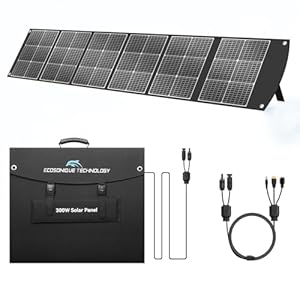
Ecosonique 300W Portable Solar Panel
80.0p per rated watt with a 24-month warranty stated, about 360Wh on an average London December day.
£239.99
Check price on Amazon
Anker SOLIX PS400 400W Bifacial Portable Solar Panel
The only bifacial panel here, with a 5-year warranty and IP68 stated, at 137.3p per rated watt.
£549.00
Check price on Amazon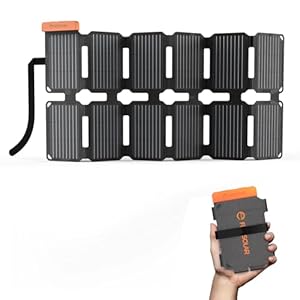
FlexSolar 36W Ultra-Portable Solar Panel Charger
The lowest outright cost of the six and the cheaper watt of the two small USB panels, at 150.0p per rated watt.
£53.99
Check price on AmazonAffiliate links. As an Amazon Associate, Look Into earns from qualifying purchases. Product prices and availability are accurate as of 23 November 2026 11:01 am and are subject to change. These labels are Look Into editorial picks among the listings this guide compares, made from desk research. They are not test results, certifications or awards from Amazon or any third party, and they cannot be bought. Award standards · See every LookInto Winner.
How this page was made
Prices and specs last checked by Look Into on 23 November 2026 · next check 18 January 2027 · how we picked
Prices in this table come from Amazon and are refreshed at least once a day, with the date of the last update under the table. The cost-per-use and running-cost figures on this page use prices Look Into read on 23 November 2026, so they can differ from today's price.
Compare live prices for every pick



As an Amazon Associate, Look Into earns from qualifying purchases. Product prices and availability are accurate as of 23 November 2026 11:00 am and are subject to change.
The wattage on the box is a laboratory figure
A panel's rated watts are measured under standard test conditions: sunlight of 1,000 watts per square metre, a spectrum known as air mass 1.5, and solar cells held at 25°C. Penn State's course notes on reading a panel datasheet call this the most widely used rating standard, and say that in practice panels rarely operate in those conditions. A British winter sun is lower, weaker and filtered through more cloud.
We read the first 20 standalone portable panels in Amazon UK's unsponsored results for "portable solar panel" on 23 November 2026, leaving out power station bundles and solar power banks. In each one we searched the title, bullet points, product description and specification tables.
- 0 of 20 name standard test conditions, or the 1,000 watts per square metre the rating assumes.
- 2 of 20 say the rating is a laboratory figure. One unbranded 100W listing says it was "Rated 100W in lab conditions", and a FlexSolar 20W listing says its wattage "is tested in an ideal laboratory".
- 13 of 20 quote an efficiency percentage, from 22% to 25.5%. Some call it a cell efficiency, which describes the cells rather than the whole panel, so it says nothing about what the panel will deliver.
- 3 of 20 warn that cloud reduces output. Another 3 promise the opposite, that the panel keeps working well in cloudy, overcast or low light conditions, without a figure.
None of this makes the wattage wrong. It makes it a ceiling, and the useful question is how far below that ceiling a UK winter sits.
What a rated watt makes in a UK winter
PVGIS is the European Commission Joint Research Centre's solar model. We asked it, on 23 November 2026, what a 100W crystalline silicon panel fixed at 35 degrees and facing due south would make in five UK cities, with 14% system losses and its SARAH-3 sunlight record for 2005 to 2023. The answers are daily averages across good and bad days.
| City | Average December day, per 100W | Average June day, per 100W | Whole year, per 100W |
|---|---|---|---|
| London | 120Wh | 410Wh | 101.9kWh |
| Cardiff | 100Wh | 440Wh | 104.2kWh |
| Manchester | 90Wh | 370Wh | 88.6kWh |
| Belfast | 80Wh | 390Wh | 91.9kWh |
| Edinburgh | 70Wh | 370Wh | 90.3kWh |
So a rated watt makes about 1.2 watt-hours on an average London December day, and about 0.7 in Edinburgh. A London June is 3.4 times better than a London December. In Edinburgh the gap is 5.3 times. A panel propped on its own stand, moved around and sometimes shaded will usually do worse than the fixed panel PVGIS models, so treat these as the most you can plan on.
How we ranked these six
The ranking metric is pence per rated watt: the Amazon UK buy box price read on 23 November 2026, divided by the panel's rated wattage. We do not print the price itself, because Amazon's rules only allow the live figure, which the table above pulls. Pence per rated watt is the fairest single comparison because every panel's output scales with its rating under the same sky, so a cheaper watt is a cheaper watt-hour, provided the panel fits what you plug it into.
Each pick had to be in stock with an add-to-cart button on 23 November 2026, and present in Amazon's product feed so the live table can show it. Two of the cheapest-per-watt panels in the search were left out for that reason: a MHPOWOS 110W and its 220W sister, both absent from the feed. A 40W panel from Mimdixy was cheaper per watt than anything here, but its listing gives no weight, connection type or weatherproofing, so there was nothing to check it against.
| Panel | Rated watts | Pence per rated watt | Weight | Watts per kg | Average December day, London | Average December day, Edinburgh | Connections stated |
|---|---|---|---|---|---|---|---|
| DOKIO 110W kit | 110W | 77.3p | 2.4kg | 45.8 | 132Wh | 77Wh | 10A charge controller, SAE to XT60 lead |
| Renogy 200W N-Type | 200W | 77.6p | 6.3kg | 31.7 | 240Wh | 140Wh | MC4, USB-C PD up to 45W, USB-A |
| Ecosonique 300W | 300W | 80.0p | 7kg | 42.9 | 360Wh | 210Wh | 3m MC4 lead, XT60, Anderson and DC8020 adapters |
| Anker SOLIX PS400 bifacial | 400W | 137.3p | 10kg with stand | 40.0 | 480Wh | 280Wh | Not stated in the text we read |
| FlexSolar 36W | 36W | 150.0p | 0.77kg (1.7lb) | 46.7 | 43Wh | 25Wh | USB-A, USB-C, DC 5.5mm |
| Anker SOLIX PS30 | 30W | 196.7p | 1.1kg | 27.3 | 36Wh | 21Wh | USB-A, USB-C |
The six panels, cheapest rated watt first
DOKIO 110W 18V Portable Foldable Solar Panel Kit
At 77.3p per rated watt this is the cheapest watt on the page, and at 2.4kg it carries 45.8 watts per kilo, the most of the larger panels. It comes as a kit with a 10A charge controller and an SAE to XT60 lead, the parts you need to charge a 12V leisure battery directly. On an average London December day it can be expected to make about 132Wh, and about 77Wh in Edinburgh.
The catch: the listing states no waterproof rating and no warranty term in its bullets, description or specification tables, and it calls its cells high efficiency monocrystalline without giving a figure. It is built around a 12V battery and its own controller, so check your power station's solar input before relying on the XT60 lead.
Price: check the live price on Amazon.
Check price on Amazon →Renogy N-Type Foldable Solar Panel 200W
77.6p per rated watt is 0.3p behind the DOKIO, and for that you get a listing that states IP65 splash and dust resistance, one MC4 output for a power station, a USB-C PD port of up to 45W and USB-A ports. Its 200W makes about 240Wh on an average London December day, roughly 23% of a 1,024Wh power station, and about 140Wh in Edinburgh. The listing claims 25% efficiency.
The catch: 6.3kg is 31.7 watts per kilo, the heaviest per watt of the larger panels here, so it is a car-boot panel rather than a rucksack one. IP65 is the rating its listing describes as splash and dust resistant, so it is not a panel to leave out in a downpour. The text we read states no warranty term.
Price: check the live price on Amazon.
Check price on Amazon →Ecosonique 300W Portable Solar Panel, 40V MC4
80.0p per rated watt, with a 3m MC4 lead and XT60, Anderson and DC8020 adapters in the box and a 24-month warranty stated on the listing. At 7kg it manages 42.9 watts per kilo. On an average London December day it can be expected to make about 360Wh, which is more than a third of a 1,024Wh power station, and about 210Wh in Edinburgh. The listing quotes a 23.5% conversion rate.
The catch: the title gives 40V, and a power station whose solar input tops out below that cannot use it, so check the input voltage range in your station's manual first. Folded it measures 58.5 by 48.5 by 7.5cm on the listing, a large flat case to store.
Price: check the live price on Amazon.
Check price on Amazon →Anker SOLIX PS400 400W Bifacial Portable Solar Panel
The only bifacial panel here: its listing says the rear face collects light reflected from surfaces such as snow, sand or concrete. It states a 5-year warranty and IP68, and weighs 10kg including its stand. Counting the front face only, it can be expected to make about 480Wh on an average London December day and about 280Wh in Edinburgh. The listing claims 25%+ conversion efficiency.
The catch: 137.3p per rated watt is 77% more than the Renogy for each watt of front-face rating. The rear-face gain depends on what the panel stands on, and the listing gives no figure for it, so the premium is a bet on your ground. Amazon showed only two left in stock on 23 November 2026.
Price: check the live price on Amazon.
Check price on Amazon →FlexSolar 36W Ultra-Portable Solar Panel Charger
The lowest outright cost of the six, and at 150.0p per rated watt the cheaper watt of the two small USB panels here. It weighs 1.7lb, about 0.77kg, has USB-A, USB-C and a DC 5.5mm output, and the listing states IP67. On an average London December day it can be expected to make about 43Wh, and about 25Wh in Edinburgh.
The catch: small USB panels charge devices directly, and the December figure is an average across bright and dull days, so on a grey day expect a fraction of it. The listing gives no efficiency figure and no warranty term in the text we read.
Price: check the live price on Amazon.
Check price on Amazon →Anker SOLIX PS30 30W Foldable Portable Solar Panel
A 1.1kg panel with USB-A and USB-C ports, IP65 weather resistance and an 18-month warranty stated on the listing. On an average London December day it can be expected to make about 36Wh, and about 21Wh in Edinburgh.
The catch: 196.7p per rated watt is the dearest watt on the page, 31% more than the FlexSolar 36W for 6W less rating. What the extra buys is mainly the stated warranty and the brand. The listing gives no efficiency figure.
Price: check the live price on Amazon.
Check price on Amazon →Will a portable panel cut your electricity bill?
Barely. At the October to December 2026 price cap rate of 26.32p a kWh, the 120Wh a 100W panel makes on an average London December day would cost about 3.2p to buy from the grid. Even the 400W Anker's front face makes about 12.6p worth.
Across a whole year the sums look better on paper. PVGIS gives 101.9kWh a year for each 100W in London, worth about £26.81 at 26.32p. On that basis the three big panels here would earn back their 23 November price in roughly three years, and the Anker PS400 in about five. That assumes the panel sits out facing south all year and every watt-hour it makes replaces a unit you would otherwise buy, which is not how a folding panel is usually used. If cutting the bill is the aim, a panel fixed in place does the job better: see our guide to plug-in solar panels in the UK.
Before you buy: match the panel to what it charges
- Voltage. A power station accepts solar input within a voltage range printed in its manual. A panel above that range cannot charge it. This matters most for the 40V Ecosonique.
- Wattage. A station with a 200W solar input gains nothing from a 300W or 400W panel on a bright summer day. In a UK December, when panels run far below their rating, the extra watts help more.
- Plug. MC4, XT60, Anderson and DC8020 are not interchangeable. Check which your station or battery takes, and whether the panel ships with that lead or an adapter.
- Weather rating. IP65 on these listings is described as splash and dust resistance. IP67 and IP68 claim more. None of the six is designed to be left out unattended through winter.
- Our related research. What a power station actually stores is in the best portable power stations UK guide, and the solar panels hub covers roof systems.
How Look Into made this guide
Desk research only. We have not used, tested or photographed any of these panels. We read the first 20 standalone panels in Amazon UK's unsponsored search results for "portable solar panel" on 23 November 2026, plus three further listings found lower in the same search, and opened every product page we cite. Picks are ranked on pence per rated watt from the buy box price that day. December yields come from the European Commission's PVGIS model and the bill figures from the Ofgem price cap for 1 October to 31 December 2026. We earn a commission on Amazon purchases, and it plays no part in the order or the awards.
Frequently asked questions
How much does a 100W solar panel produce in the UK in winter?
On an average December day about 120Wh in London, 100Wh in Cardiff, 90Wh in Manchester, 80Wh in Belfast and 70Wh in Edinburgh, according to the European Commission's PVGIS model for a panel fixed at 35 degrees facing south. Those are averages across bright and dull days.
Can a portable solar panel charge a power station in winter?
Partly. A 200W panel makes about 240Wh on an average London December day, roughly 23% of a 1,024Wh power station. It will top a station up during a power cut rather than refill it in a day.
What does the wattage on a solar panel mean?
It is the output under standard test conditions: sunlight of 1,000 watts per square metre at the air mass 1.5 spectrum, with the cells at 25°C. None of the 20 Amazon UK listings we read on 23 November 2026 named those conditions.
Will a portable solar panel cut my electricity bill?
Not by much. A 100W panel's average London December day is worth about 3.2p at the 26.32p price cap rate. Panels fixed in place, such as plug-in or roof systems, are the way to cut a bill.
Sources
- PVGIS 5.3, European Commission Joint Research Centre, monthly output for a 100W panel in London, Cardiff, Manchester, Belfast and Edinburgh, read 23 November 2026
- Penn State AE 868, Interpreting PV Manufacturer Datasheet, on standard test conditions, read 23 November 2026
- Look Into, Ofgem price cap October to December 2026, for the 26.32p a kWh electricity rate
- Amazon UK listings for the 20 audited panels and the six picks, read 23 November 2026
Prices behind the pence per watt figures are the Amazon UK buy box read on 23 November 2026 and move without warning. The comparison table at the top of this page pulls live prices from Amazon's feed, which can sit off the buy box. Look Into has not handled these products: every figure comes from the maker, the listing or a named source, read on the date shown. We earn a commission if you buy through a link on this page, at no extra cost to you, and it never changes a verdict.
 Solar PanelsPlug-in solar panels UK 2026: the rules, what they save and what 20 listings tell you
 Claims Checked10 of 20 home batteries put a bigger number in the name than you can use
 Household SavingsThe UK Solar Panel Payback Index 2026
 Solar PanelsHow to Choose a Solar Panel Installer UK 2026: What to Check, Red Flags and Getting the Best Quote