Read aloud by your device’s built-in voice. Tables and price boxes are skipped.
The short answer (prices checked 17 November 2026)
- Cheapest filtered water of the six is Aqua Optima Evolve+, £9.70 for four cartridges. That is £2.43 a cartridge and £1.62 for every 100 litres, using the 150 litre rating its own listing states.
- Brita's own MAXTRA PRO Pure Performance is £15.49 for four, so £3.87 a cartridge and £2.58 per 100 litres. Same stated 150 litres, about 60 per cent more for each one of them.
- Two of the six state no capacity anywhere on the listing, so there is no honest cost per litre to publish for them. That gap is the finding rather than an omission here.
- Audit finding: of the first 20 unsponsored Amazon UK results for "water filter cartridges", read on 17 November 2026, all 20 claim to cut lead, heavy metals or microplastics. Five cite NSF/ANSI 53, the one standard among those named that tests whether a filter removes health-related contaminants.
Brita's MAXTRA PRO cartridge sat at number 7 in the whole Home & Kitchen chart on Amazon UK on 17 November 2026, which is where you expect to find a consumable in the run-up to Christmas rather than a jug. The jug is a one-off. The cartridge is the bit you keep buying, four to thirteen times a year depending on which rule you follow, and it is the bit nobody prices properly.
Two things are missing from every listing we read. Nobody tells you what filtered water costs a litre, and nobody tells you which of the three NSF standards their "NSF certified" line refers to. The second one matters more than it sounds, because only one of those three standards is about removing anything from your water.
Also awarded in this guide

BRITA MAXTRA PRO Pure Performance, 4 pack
The only pick of the six whose listing cites NSF/ANSI 53, the standard that tests health related removal.
£15.49
Check price on Amazon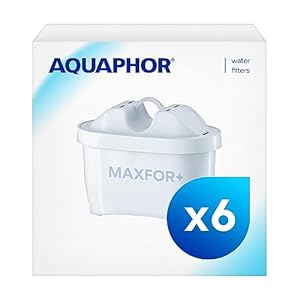
AQUAPHOR Maxfor+, 6 pack
Claims 200 litres a cartridge in its bullet points, more than anything else here, though its own title says 250.
£18.99
Check price on Amazon
FilterLogic FL402H, universal 6 pack
Two pounds a cartridge, the lowest unit price of the six, from a UK filter brand.
£11.99
Check price on Amazon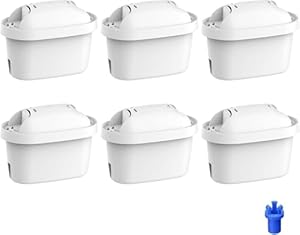
Waterdrop water filter cartridges, 6 pack
The only pick citing NSF/ANSI 42, the standard whose claim list covers chlorine, taste and odour.
£12.99
Check price on AmazonAffiliate links: as an Amazon Associate, Look Into earns from qualifying purchases. Prices change. These labels are Look Into editorial picks from desk research, not test results and not awards from Amazon or any third party. How we pick · See every LookInto Winner.
How this page was made
Prices and specs last checked by Look Into on 17 November 2026 · next check 12 January 2027 · how we picked
Prices in this table come from Amazon and are refreshed at least once a day, with the date of the last update under the table. The cost-per-use and running-cost figures on this page use prices Look Into read on 17 November 2026, so they can differ from today's price.
Compare live prices for every pick



As an Amazon Associate, Look Into earns from qualifying purchases. Product prices and availability are accurate as of 17 November 2026 10:39 am and are subject to change.
"NSF certified" is three separate standards and only one is about removal
NSF publishes the numbers in its own knowledge library, so this is checkable in a couple of minutes. The three that turn up on cartridge listings do very different jobs.
NSF/ANSI 42 is the aesthetic effects standard. NSF lists its claims as chlorine, taste and odour, chloramine, particulate, iron, manganese, zinc and total dissolved solids. Nothing on that list is health related.
NSF/ANSI 53 is the health effects one. NSF describes it as covering specific health-related contaminants, with over 50 reduction claims available including lead, Cryptosporidium, VOCs and chromium. This is the number that backs a lead claim.
NSF/ANSI/CAN 372 is about lead content. NSF's own page on it says the standard "addresses lead content only", with a maximum weighted lead content of 0.25 per cent for most components. It governs whether the plastic and metal in the product leach lead into your water, and it says nothing about whether the product takes lead out.
Put those together and you can read a listing properly. A cartridge citing 42 and 372 has cited evidence that it improves the taste and that its own materials are low in lead. It has cited nothing about pulling lead out of your tap water, which is the claim sitting two lines above in the bullet points.
Worth saying plainly: a cartridge with no standard named is not therefore a bad cartridge, and these are all American standards with no UK equivalent in play. What the standard does is move a claim from asserted to graded, and on this product category almost nobody takes that step.
Every cartridge has two expiry rules, and they only agree at one daily usage
Brita's MAXTRA PRO listing puts it as "filter up to 150 L in 4 weeks". The Amazon Basics listing is blunter: "Replace every 30 days or after 150 L, depending on water hardness." Both rules on one cartridge, and whichever comes first wins.
Those two rules describe the same cartridge only if you filter 5.4 litres a day, which is 150 divided by 28. On the 30 day version it is 5.0 litres a day. Above that figure the litres run out and the date on the lid is flattering you. Below it, the date comes round while the carbon still has capacity in it and you throw the difference away.
How far below is the useful question. The NHS puts the target at 6 to 8 cups or glasses of fluid a day and does not say how big a glass is, so take 250 ml and two adults drinking eight glasses each. That is 4 litres a day, and not all of it comes out of the jug. Four litres a day for four weeks is 112 litres, so a cartridge rated at 150 goes in the bin with about a quarter of its rated capacity unused, every time, thirteen times a year.
It runs the other way in a bigger household. Four people on the same 2 litres each are at 8 litres a day and hit 150 litres in nineteen days, so the four week date is nine days too generous. Hard water pulls the same direction, which is what Amazon Basics means by "depending on water hardness", and is the one variable neither rule puts a number on.
How we picked these
We read the first 20 unsponsored Amazon UK results for "water filter cartridges" on 17 November 2026, then opened every candidate's own product page and read the price out of the buy box, the pack count out of the title and the capacity and replacement rule out of the bullet points, the technical specification table and the product description. Six made the list because each one does something the other five do not: one is Brita's own, one is a rival system rather than a copy of Brita's, one claims the highest capacity, one states its replacement rule in both units, one is the cheapest cartridge on the page and one is the only pick citing the taste standard.
Cost per 100 litres is the pack price divided by the pack count, divided by the capacity the listing itself states. Where a listing states no capacity we have left the column blank rather than borrow a figure from a product that looks similar. Look Into has not handled these products: every figure comes from the maker, the listing or a named source, read on the date shown.
| Cartridge | Pack | Price 17 Nov 2026 | A cartridge | Capacity stated | Per 100 litres |
|---|---|---|---|---|---|
| Aqua Optima by LAICA Evolve+ | 4 | £9.70 | £2.43 | 150 litres, 30 days | £1.62 |
| AQUAPHOR Maxfor+ | 6 | £18.99 | £3.17 | 200 litres in the bullets, 250 in the title | £1.58 at 200 litres |
| Amazon Basics | 6 | £16.49 | £2.75 | 150 litres or 30 days | £1.83 |
| BRITA MAXTRA PRO Pure Performance | 4 | £15.49 | £3.87 | 150 litres in 4 weeks | £2.58 |
| FilterLogic FL402H | 6 | £11.99 | £2.00 | none stated | cannot be worked out |
| Waterdrop | 6 | £12.99 | £2.17 | none stated | cannot be worked out |
Aqua Optima by LAICA Evolve+, 4 water filters
The cheapest filtered water here on a capacity anyone else also claims. Its listing states a 150 litre cartridge and four filters lasting up to 120 days, which is the same 150 litres and the same monthly clock as Brita's own, at £2.43 a cartridge instead of £3.87. It is a rival jug system rather than a copy of Brita's cartridge, and the listing says it fits Brita jugs too.
The catch: no NSF number of any kind on the listing, so the limescale and taste claims sit unsupported by a named standard, and if you run a Brita jug with the electronic cartridge reminder the Evolve+ will not talk to it.
Check price on Amazon →BRITA MAXTRA PRO Pure Performance, 4 pack
The one on the chart, and the only pick of the six whose listing cites NSF/ANSI 53, the health effects standard. It is also the only one that states its capacity and its clock in the same breath, as "filter up to 150 L in 4 weeks", and it carries a footnote saying the litre figure comes from performance tests. That is three steps further than most of this category goes.
The catch: £2.58 per 100 litres against £1.62 for the Aqua Optima on the same stated 150 litres, so you are paying about 60 per cent more for every litre, and the PRO shape means a jug bought for the older MAXTRA cartridge may want a different one.
Check price on Amazon →AQUAPHOR Maxfor+, 6 pack
Claims more litres than anything else on the list, which is what drops its cost per 100 litres to £1.58. If the figure holds it is the cheapest water here, and six cartridges at a stated 200 litres each is a year and a half of filtering for £18.99.
The catch: the listing contradicts itself. The title says "Up to 250L Filtered Water" and the bullet points say it "lasts up to 200 liters", a 25 per cent difference on the only number that decides whether this is good value. We have costed it at the lower of its own two figures, and there is no standard cited behind either.
Check price on Amazon →Amazon Basics water filter cartridges, 6 count
The clearest instruction on the page: "Replace every 30 days or after 150 L, depending on water hardness." Both numbers, the word "or" between them, and an admission that your water decides which one bites first. At £2.75 a cartridge it sits in the middle of the group on price and second on cost per litre.
The catch: no NSF number cited anywhere on it, and like every compatible cartridge here it is a third party part in someone else's jug, so a fit complaint is yours to sort out rather than Brita's.
Check price on Amazon →FilterLogic FL402H, universal 6 pack
Two pounds a cartridge, the lowest unit price of the six, and a UK filter brand that sells into fridges and coffee machines as well as jugs. If you change cartridges on the calendar and buy on price, this is the cheapest way to keep doing that.
The catch: its listing states no litre capacity and no replacement interval, which is why the cost per litre column is blank rather than low. Cheapest a cartridge and unknown a litre are not the same claim, and on this one you are buying the first without being told the second.
Check price on Amazon →Waterdrop water filter cartridges, 6 pack
The only pick citing NSF/ANSI 42, which is the standard whose claim list includes chlorine, taste and odour. If the reason you own a jug is that your tap water tastes of the treatment works, this is the one pick on the list with a named standard behind that particular job. It also cites NSF/ANSI 372 on lead content of its own materials.
The catch: the bullet points also claim it tackles heavy metals, and neither 42 nor 372 tests for that. 42 is taste and 372 is what the plastic puts in rather than what the carbon takes out. No capacity is stated either, so there is no cost per litre to publish.
Check price on Amazon →What a year of filtered water costs
Follow the clock rather than the litres, which is what most people do because the clock is the bit the jug reminds you about, and the annual bill falls out of the pack price. Thirteen cartridges a year on a four week rule, 12.2 on a 30 day rule.
| Cartridge | Stated rule | Cartridges a year | A year at 17 Nov 2026 prices |
|---|---|---|---|
| Aqua Optima Evolve+ | 30 days | 12.2 | £29.50 |
| Amazon Basics | 30 days or 150 litres | 12.2 | £33.44 |
| AQUAPHOR Maxfor+ | none stated, costed at 30 days | 12.2 | £38.51 |
| BRITA MAXTRA PRO | 4 weeks or 150 litres | 13.0 | £50.34 |
| FilterLogic FL402H | none stated, costed at 30 days | 12.2 | £24.31 |
| Waterdrop | none stated, costed at 30 days | 12.2 | £26.34 |
The spread is £24 to £50 a year for the same job in the same jug, and the dearest is the one with the standard behind it. Whether that is worth £26 a year is your call, and it is a real call rather than a trick question: NSF/ANSI 53 is the only cited evidence on this whole page that any of these cartridges removes something you would rather not drink.
Claims audit: 20 listings, 20 health claims, 5 health standards
We read the first 20 unsponsored Amazon UK search results for "water filter cartridges" on 17 November 2026 and counted, scoped to the product title, the feature bullets, the technical specification tables and the product description only. Reviews, question and answer sections and store pages were left out of the count.
| Counted in the first 20 unsponsored results | How many |
|---|---|
| Claim to reduce lead, heavy metals, microplastics or pesticides | 20 of 20 |
| Cite NSF in any form | 12 of 20 |
| Cite NSF/ANSI 53, the health effects standard | 5 of 20 |
| Make a health related claim with no standard named at all | 8 of 20 |
| State a capacity in litres | 9 of 20 |
| Cite DIN 10521 or any European or British standard | 0 of 20 |
| State a cost per litre of filtered water | 0 of 20 |
The one line to take away: more than half this category's health claims rest on a standard that tests taste, a standard that tests the product's own lead content, or on nothing. Of the six picks above, one cites 53, one cites 42 and 372, and four cite nothing.
Questions people ask
Do compatible cartridges damage a Brita jug?
No listing we read claims a risk to the jug and Brita makes no such claim either, so there is nothing to report in that direction. The practical difference is the fit and the reminder. A compatible cartridge is a third party part, so if it seats badly or drips round the rim you are dealing with that seller rather than with Brita, and the electronic cartridge indicators built into some jugs are counting days rather than reading the cartridge, so they carry on counting whatever you put in.
Which rule should I follow, the four weeks or the 150 litres?
Whichever comes first, which is what the listings themselves say. For most two person households the four weeks arrives first and you bin unused capacity. For a household of four, or in a hard water area, the litres go first and the date is too generous. If you want one number to work with, 5 litres a day is roughly where the two rules meet on a 150 litre cartridge.
Is filtering tap water in the UK worth doing at all?
That depends on what you want out of it, and the standards above are the honest guide. Taste and chlorine are the claims with cited evidence behind them on this category, and they are also the reason most people buy a jug. Health related removal is the claim that mostly lacks a cited standard here. UK mains water already arrives under the Water Supply (Water Quality) Regulations, so a jug is improving on a supply that is already regulated rather than making unsafe water safe.
Why is there no cost per litre for two of the picks?
Because their listings do not say how many litres a cartridge treats, and we are not going to borrow a figure from a product that looks similar and present it as theirs. Eleven of the 20 listings we read are in the same position. It is a reasonable thing to ask a seller before you buy six of them.
Does a dearer cartridge filter better?
On this list the dearest is also the only one citing the health effects standard, so there is a thread connecting price to evidence. It is one data point in six and not a rule. The £2.00 FilterLogic and the £3.87 Brita both state the same promise in their bullet points, and only one of them points at a test.
Sources
- NSF, NSF/ANSI 42, 53 and 401 filtration systems standards, read 17 November 2026
- NSF, NSF/ANSI/CAN 372 technical requirements, lead content, read 17 November 2026
- NHS, Water, drinks and your health, on 6 to 8 glasses of fluid a day, read 17 November 2026
Prices are the Amazon UK buy box read on 17 November 2026 and move without warning. The comparison table at the top of this page pulls live prices. Look Into has not handled these products: every figure comes from the maker, the listing or a named source, read on the date shown. Look Into is a participant in the Amazon EU Associates Programme and earns from qualifying purchases, at no extra cost to you.
 Household SavingsOven running costs UK: 20 best-selling built-in ovens checked, 18p to 22p a cycle
 Buying DeskBest bread makers UK 2026: what a loaf really costs to bake
 Buying DeskBest soup makers UK 2026: what a batch costs to make
 Buying DeskBest kettles UK 2026: what one cup really costs to boil
New on other desks
- Buying DeskBest bathroom sealant UK 2026: ranked by cost a metre
- Price WatchBlack Friday deals to avoid in 2026: 10 buys where the sale price is the small number
- Price WatchBlack Friday price tracker UK 2026: 74 Amazon products checked against our own record