
Key takeaways
- Any shop that sells more than 32kg of portable batteries a year has to take your dead ones back free, and it cannot make you buy new ones to do it. That is regulation 31 of the Waste Batteries and Accumulators Regulations 2009.
- The recycling cost is already inside the price on the shelf. Regulation 34 bans a retailer from showing it to you as a separate line at the till.
- Recharging one AA costs roughly a tenth of a penny. At the Ofgem cap rate of 26.32p per kWh from 1 October 2026, a 2,000mAh cell takes about 0.09p of electricity per charge.
- Batteries are 17 of the top 30 on Amazon UK’s Electronics chart today, and the clocks go back on 25 October 2026.
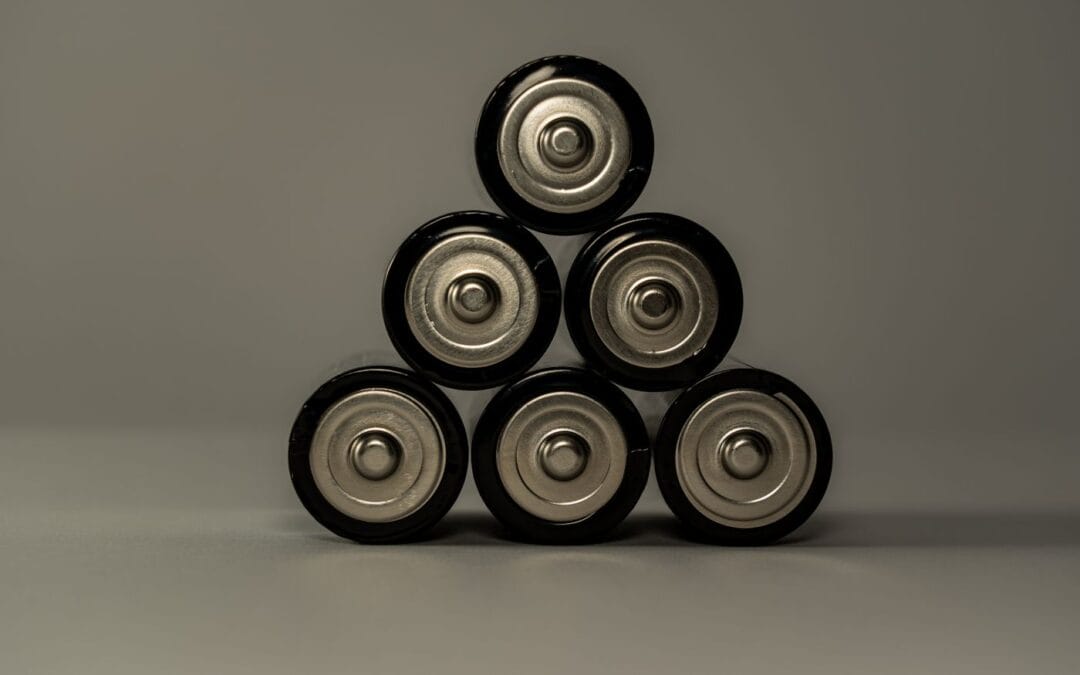
Batteries are having a moment on the Amazon UK charts, and it is not subtle. When we read the Electronics best sellers on 22 September 2026, seventeen of the top thirty were batteries. AA alkalines held number one, number three, number four and number seven. Coin cells took number two and number six. Rechargeables sat at twenty six and twenty seven. Nothing else in the chart comes close to that kind of density.
The timing makes sense. The clocks go back at 2am on Sunday 25 October 2026, which is the point in the year when half the country notices its smoke alarms, its bike lights and its torches at the same time. Add a quarter of a million remote controls that stopped working over the summer and you get a chart that looks like this.
Plenty of sites will tell you which AA lasted longest in a lab. We have not run a lab test and we are not going to pretend we did. What we can do is read the law, read the manufacturers’ own datasheets, and do the arithmetic on today’s prices. What came out of that does not appear on the review pages at all.




As an Amazon Associate I earn from qualifying purchases. (paid link)
Prices and specs last checked 22 September 2026 · next check 1 November 2026 · how we picked
The takeback law nobody prints on the packet
Regulation 31 of the Waste Batteries and Accumulators Regulations 2009 is short and it is blunt. A distributor of portable batteries must, at any place it supplies them to end users, take back waste portable batteries at no charge, and tell people at its sales points that it does. It may not charge you. It may not oblige you to buy a new battery in exchange.
So the collection bin near the door of your supermarket is not a favour. It is a legal duty, and you can use it without buying anything at all. The shop then has a right under regulation 32 to have a compliance scheme collect the pile for free within 21 days of asking.
There is one exemption, and it is worth knowing because it explains the shops that have no bin. Regulation 31(5) defines a small distributor as one who supplies less than 32 kilograms of portable batteries to end users in a year. Small distributors are outside the duty. Thirty two kilograms of AA cells is roughly fourteen hundred batteries, so a corner shop with a spinner rack by the till may genuinely fall under it. A supermarket does not.
Regulation 34 is the one we find most useful as a shopper. It says a distributor must not show separately the costs of collection, treatment and recycling of waste portable batteries at the time of sale. In plain terms, the recycling is already paid for inside the price you see on the shelf. If a retailer ever adds a recycling line to your receipt for a pack of AAs, that is not permitted.
What a recharge actually costs
Every rechargeable battery review says you save money. Almost none of them say how much the electricity costs, which is odd, because it is a short sum and the rate is published.
Ofgem set the price cap for 1 October to 31 December 2026 on 26 August. Electricity on a standard variable tariff paid by direct debit averages 26.32p per kWh across England, Scotland and Wales, with a 54.83p daily standing charge, and it carries no VAT from 1 October 2026 to 31 March 2027. The standing charge does not change when you plug a charger in, so we have left it out. If you want the same sum run over kettles, heaters and dehumidifiers, our appliance running cost calculator uses the same rate.
A 2,000mAh NiMH AA holds 2,000 milliamp hours at a nominal 1.2 volts, which is 2.4 watt hours. Chargers waste some of what they draw, mostly as heat, so the wall takes more than the cell stores. We have run the sum at three efficiencies rather than pick one and present it as fact.
| Charger efficiency assumed | Energy drawn per charge | Cost per charge at 26.32p/kWh |
|---|---|---|
| 100 per cent (impossible, shown as a floor) | 2.4 Wh | 0.063p |
| 70 per cent | 3.43 Wh | 0.090p |
| 50 per cent (pessimistic) | 4.8 Wh | 0.126p |
Call it a tenth of a penny. The Amazon Basics rechargeable AA we picked below is rated for up to 1,000 recharges and costs £1.00 a cell at today’s price. If it hits that rating, you would spend about 90p of electricity across its whole life, so £1.90 buys you a thousand discharges. The same thousand discharges from the cheapest bulk alkaline in this guide would cost about £355.
Two honest caveats. You need a charger, which is a one off cost we have not included because it depends on what you buy. And a rated cycle count is a laboratory figure, not a promise. Even if you only get a fifth of it, the arithmetic still lands a long way apart.
Why “heavy duty” is the weaker option
Sitting at number twenty in today’s Electronics chart is an eight pack of Eveready Super Heavy Duty AAA at £3.39. The name suggests it is the tough one. It is the older chemistry.
Energizer publishes datasheets for both, and they are free to read. The alkaline AAA sheet classifies the cell as alkaline, gives a milliamp hour capacity chart running to 1,500mAh, and states a shelf life of 10 years at 21C. The Eveready Heavy Duty AAA sheet classifies the cell as carbon zinc, zinc chloride. It publishes no milliamp hour capacity chart and no shelf life figure, only service hour curves and a performance retention graph. On the shared industry remote control test, 24 ohms at 15 seconds a minute for 8 hours a day, the alkaline sheet plots service out to 24 hours and the carbon zinc sheet stops at 12.
Then look at the price per cell. That Eveready eight pack works out at 42.4p a battery. The Energizer Alkaline Power AAA 24 pack in our list below is 22.8p a battery. The older, thinner chemistry costs nearly twice as much per cell today. Check the price per cell rather than the price on the front of the pack and a lot of the shelf stops making sense.
How we picked these
This is desk research, not a hands on test. We read the Amazon UK Electronics best sellers on 22 September 2026 and took our shortlist from the top thirty, so every product here is something large numbers of people in Britain are actually buying right now. We then opened each product page individually, read the title off the listing, confirmed it was in stock, and recorded the price we saw on the day.
From there we worked out the price per cell, because pack sizes run from four to sixty and the headline price tells you almost nothing. We gave each pick one job rather than ranking them against each other, since an AA for a wall clock and an AA for a camera flash are not competing for the same slot. Where a claim needed checking we went to the primary source, which for the law means legislation.gov.uk and for the chemistry means the manufacturer’s own datasheet. Every source we used is linked at the bottom and we opened all of them today.
What we could not check: we have not measured capacity, run down a single cell, or verified any manufacturer’s cycle life claim. Where we quote a rated figure, it is the seller’s number and we say so.
How they compare
| Pick | Best for | Pack | Price | Per cell | Chart |
|---|---|---|---|---|---|
| Amazon Basics AA Alkaline | Everyday AA in bulk | 20 | £7.10 | 35.5p | #1 |
| Duracell Optimum AA | High drain devices | 12 | £9.95 | 82.9p | #12 |
| Amazon Basics Rechargeable AA | Anything you refill often | 8 | £8.02 | £1.00 | #27 |
| Energizer Alkaline Power AAA | AAA in bulk | 24 | £5.46 | 22.8p | #19 |
| Amazon Basics Rechargeable AAA | Remotes and small gear | 8 | £6.25 | 78.1p | #26 |
| Duracell CR2032 | Key fobs and coin cells | 4 | £4.44 | £1.11 | #2 |
The six we would buy
Amazon Basics 20-Pack AA Alkaline High-Performance Batteries
£7.10 for 20 · 35.5p a cell · number 1 in Electronics
The best seller on the whole Electronics chart, and for once the crowd has it about right. At 35.5p a cell this is the drawer battery: clocks, remotes, the kitchen scale, the kids’ toys that eat four at a time. Amazon states a 10 year shelf life, so a twenty pack bought now is not going to die in the cupboard before you get through it.
If you genuinely burn through AAs, the Kodak 60 pack at number 25 works out fractionally cheaper at 33.3p a cell for £19.99. That is a difference of about 2p a battery, which only matters at volume.
The catch: ordinary alkaline is a poor fit for high drain kit. In a camera flash or a games controller it will sag under load and you will be back in the drawer sooner than the price per cell suggests.
Check price on Amazon →Duracell Optimum AA Alkaline Batteries, 12 Pack
£9.95 for 12 · 82.9p a cell · number 12 in Electronics
Optimum is Duracell’s premium alkaline line and it is the one to reach for when the device pulls hard: flashguns, motorised toys, a controller that gets played rather than looked at. It is still alkaline, so it is not magic, but the cell is built to hold voltage better under a heavy draw than a basic one will.
At 82.9p a cell it is more than twice the price of the Amazon Basics pack. That is only worth paying where the device would otherwise chew through cheap cells, which is a much shorter list than the packaging implies.
The catch: putting these in a wall clock is money on the floor. A clock draws so little that the cheapest alkaline in the shop will run it for a year or more, and you will not notice any difference at all.
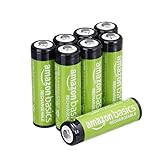
Check price on Amazon →Amazon Basics 8-Pack Rechargeable AA NiMH Batteries, 2000 mAh
£8.02 for 8 · £1.00 a cell · number 27 in Electronics
This is the pick the arithmetic above was written for. Amazon rates these for up to 1,000 recharges and ships them pre-charged, and at 26.32p per kWh each top up costs roughly 0.09p. Put eight in the devices you refill most and the payback arrives quickly, because the cost of the electricity is close to a rounding error.
NiMH sits at 1.2 volts rather than the 1.5 volts of an alkaline. Almost everything in a normal house copes with that, though the odd fussy device will complain or read the charge level wrongly.
The catch: you need a charger and it is not in the box, so budget for one on top. These also self discharge more than an alkaline does, which makes them a bad choice for a smoke alarm or an emergency torch that sits untouched for months.
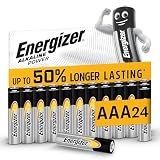
Check price on Amazon →Energizer Alkaline Power AAA Batteries, 24 Pack
£5.46 for 24 · 22.8p a cell · number 19 in Electronics
The cheapest cell per unit in this whole guide, and a straightforward buy. AAA is the size that disappears fastest, because it is what remotes, thermometers, bike lights and half the drawer take. Twenty four of them for £5.46 covers a household for a long time.
This is also the comparison that makes the carbon zinc point above land. The Eveready Super Heavy Duty AAA on the same chart costs 42.4p a cell. These are 22.8p and they are the stronger chemistry.
The catch: Alkaline Power is Energizer’s entry line, not its long life one. For a device you would rather not open again for two years, the dearer Max or Ultimate ranges are a better fit even though the per cell price looks worse.
Check price on Amazon →Amazon Basics 8-Pack Rechargeable AAA NiMH Batteries, 850 mAh
£6.25 for 8 · 78.1p a cell · number 26 in Electronics
The AAA version of the pick above, rated for up to 500 recharges rather than 1,000. Run the same sum and a charge works out at about 0.04p, so across the rated life you would spend roughly 19p of electricity per cell. Cell plus electricity comes to about 97p for 500 uses, against roughly £114 of alkaline AAAs for the same number.
The obvious home for these is the remote control that always seems to be flat, and anything else in the house that takes AAA and gets used daily.
The catch: 850mAh is genuinely small, so in a high drain device these will need charging often enough to be annoying. Same charger caveat as the AA pack, and the same warning about smoke alarms.
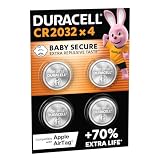
Check price on Amazon →Duracell 2032 Lithium Coin Batteries, 4 Pack, 3V CR2032
£4.44 for 4 · £1.11 a cell · number 2 in Electronics
CR2032 is the cell in your car key, your bathroom scales, most AirTag style trackers and a surprising number of bike computers. It is number two on the chart because everybody needs one eventually and nobody keeps spares. Four is the right quantity to have in the house.
Duracell puts a bitter coating on these to discourage swallowing and ships them in child resistant packaging. That is the direction the whole category has moved since PAS 7055 landed, and it is worth reading the section below before you open a pack in a house with small children.
The catch: £1.11 a cell is a premium. Generic CR2032 sells for a fraction of that, and the GP ten pack at number 14 is cheaper per cell, though you then want to check what safety packaging you are getting.
Check price on Amazon →Coin cells, children and PAS 7055
Five of today’s top thirty are coin or button cells, which is worth pausing on if there are small children in the house. A swallowed coin cell that lodges in the food pipe can burn through tissue, and it is treated as a medical emergency rather than something to watch and wait on.
Britain has a standard for this. On 30 April 2021 BSI published PAS 7055:2021, Button and coin batteries, safety requirements, sponsored by the Office for Product Safety and Standards and free to download. It covers cells up to 32mm across and sets requirements for the manufacturers, the makers of the products that use them, and the retailers: labelling, instructions, packaging, how the cells are merchandised in store, safe disposal, and the safety of the consumer products themselves.
Here is the part that gets lost. A PAS is a Publicly Available Specification, not a law. OPSS says PAS 7055 is aligned with the General Product Safety Regulations 2005, which is the legal requirement that consumer products placed on the market are safe. So the specification tells a responsible seller what good looks like, and the regulations are what actually bite. A pack that arrives in a plain bag with no child resistant packaging has not broken PAS 7055, because PAS 7055 is not the thing you break.
Practically: buy coin cells in child resistant packs, keep spares and dead ones out of reach rather than in a kitchen drawer, and if you think a child has swallowed one, go straight to A and E or call 999. A dead coin cell still holds enough charge to do damage, which is the detail most people get wrong.
Common questions
Can I put dead batteries in the bin?
Don’t. Take them back to a shop instead. Any retailer selling more than 32kg of portable batteries a year has to accept them free under regulation 31, without you buying anything, and the bin is usually just inside the entrance. Supermarkets and the larger DIY chains all qualify comfortably.
Are rechargeable batteries actually cheaper?
For anything you refill regularly, yes, and the gap is wide. A 2,000mAh NiMH AA costs about 0.09p of electricity per charge at the October 2026 capped rate. Buy the cell at £1.00 and even a fraction of its rated 1,000 cycles beats buying alkalines. For a smoke alarm or a torch that sits in a cupboard for a year, a disposable alkaline is the better choice, because NiMH loses charge while it sits.
Does 1.2V hurt devices designed for 1.5V?
Rarely. NiMH cells run at a nominal 1.2 volts against an alkaline’s 1.5, and most household kit is built with enough headroom to cope. The place you notice it is a battery level indicator, which may read low from the start because it was calibrated for an alkaline discharge curve.
Is “super heavy duty” better than alkaline?
No. Heavy duty is the trade name for carbon zinc, an older chemistry. Energizer’s published datasheets give the alkaline AAA a capacity chart and a stated 10 year shelf life, and give the heavy duty AAA neither. On today’s prices the heavy duty eight pack also costs 42.4p a cell against 22.8p for a bulk alkaline AAA.
Why are batteries selling so hard in September?
Autumn. The clocks go back at 2am on Sunday 25 October 2026, dark evenings arrive with them, and that is when people replace the cells in smoke alarms, carbon monoxide alarms, torches and bike lights. The chart follows the daylight.
Should I keep spare batteries in the fridge?
There is no need. A modern alkaline AA is sold with a 10 year shelf life at normal room temperature, and condensation when you take a cell out of a cold fridge does more harm than the slower self discharge saves. A dry drawer is fine.
Sources
Every link below was opened on 22 September 2026 and the figures quoted were read from it on the day.
- The Waste Batteries and Accumulators Regulations 2009, regulation 31 (take back), legislation.gov.uk
- Regulation 32, distributor’s right to request collection, legislation.gov.uk
- Regulation 34, prohibition on showing recycling costs separately, legislation.gov.uk
- Changes to energy price cap between 1 October and 31 December 2026, Ofgem, published 26 August 2026
- OPSS supports new standard for battery safety (PAS 7055:2021), Office for Product Safety and Standards
- When do the clocks change?, GOV.UK
- Energizer E92 AAA alkaline product datasheet (PDF), Energizer
- Eveready Heavy Duty R03 AAA carbon zinc product datasheet (PDF), Energizer
Prices and chart positions were checked on 22 September 2026 and will have moved since. Amazon prices change without notice, so treat every figure here as the price on the day rather than a quote. Look Into is a participant in the Amazon EU Associates Programme and earns from qualifying purchases made through the links on this page, at no extra cost to you. Written by Jacob Whitmore for Whito Ltd.