
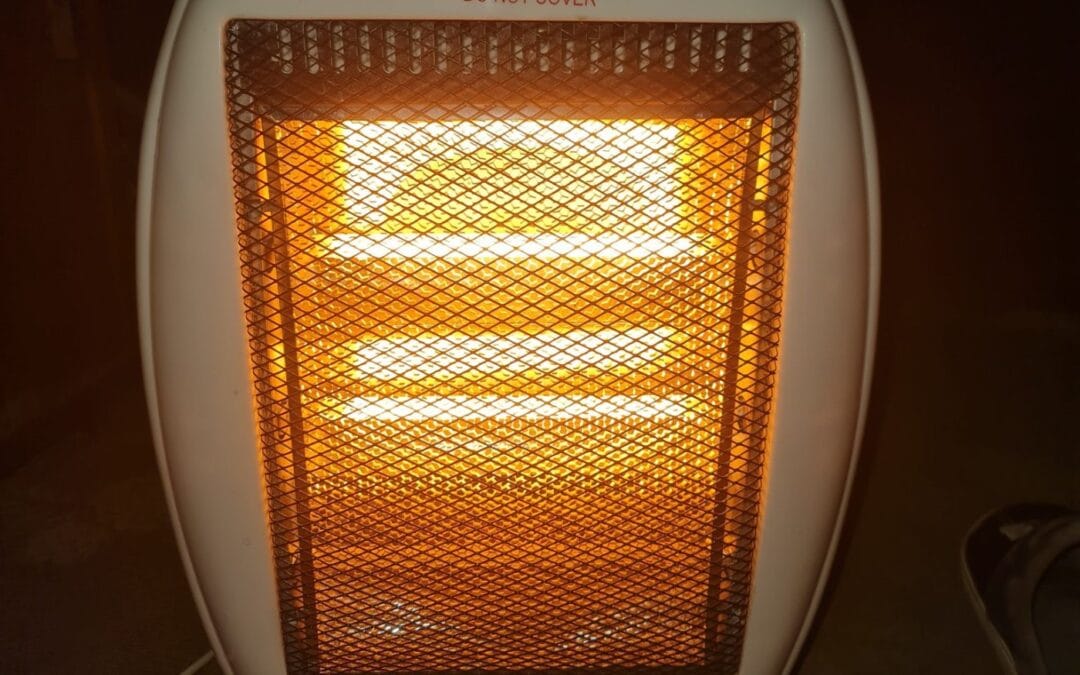
Every heater here is ranked on one number first: what it costs to run for an hour at the Ofgem cap rate that starts on 1 October 2026. The specifications are the maker's own, opened and read on 5 September 2026. There is no hands-on test here and we do not claim one. What we add is the arithmetic that almost nobody selling these heaters will put on the page, and while checking that we found something worth its own section: of 35 best-selling electric heaters on Amazon UK, not one states what it costs to run.
How Look Into made this guide: desk research, not a hands-on test. We shortlisted on UK availability and sales rank, read each maker's own published specification, and derived the running costs ourselves from the confirmed Ofgem cap rate for 1 October to 31 December 2026. Prices are what we saw on 5 September 2026 and will move. If you buy through the Amazon links we may earn a commission, and it does not change the price you pay or which heater we rank first.
The short answer. At the October 2026 cap rate of 26.32p per kWh, a 2kW plug-in heater costs 52.6p an hour and a 650W oil-filled radiator costs 17.1p. Heater type changes nothing. Wattage sets the cost, and a thermostat is the only feature that lowers it, because it is the only one that switches the heater off.
Prices and specs last checked by Look Into on 5 September 2026 · how we picked
The picks at a glance
| Pick | Model | Power | Per hour | 4 hrs a day for a month | Thermostat | Timer | Price seen | Buy |
|---|---|---|---|---|---|---|---|---|
| Cheapest to run | Dimplex 1ft Tubular Heater | 40W | 1.1p | £1.26 | Yes | No | £19.80 | Amazon |
| Best at a desk | Russell Hobbs RHPH2001 Ceramic Plug Heater | 500W | 13.2p | £15.79 | Yes | Yes, 12hr | £18.89 | Amazon |
| Cheapest whole-room heat | Russell Hobbs 650W Oil Filled Radiator, 5 fin | 650W | 17.1p | £20.53 | Yes | No | £29.00 | Amazon |
| Best all-rounder | Dreo Smart Electric Heater 1500W | 1500W | 39.5p | £47.38 | Yes | Yes, 12hr | £37.88 | Amazon |
| Best for a big room | Morphy Richards HeatFlux 2kW Upright | 2000W | 52.6p | £63.17 | Yes | Yes | £37.99 | Amazon |
| Cheapest to buy | Warmlite WL44001 Thermo Fan Heater | 2000W | 52.6p | £63.17 | None listed | No | £11.44 | Amazon |
| Best for a full evening | Pro Breeze Smart 2500W 11 Fin Oil Filled | 2500W | 65.8p | £78.96 | Yes | Yes, 24hr | £104.99 | Amazon |
Live prices, updated automatically. The Russell Hobbs 650W oil-filled radiator is not carried by Amazon's product data feed, so it sits in our table above but cannot appear in this one; its price was read on its own listing on 5 September 2026.
Prices in this table come live from Amazon and can change through the day. Prices quoted in the text were checked by Look Into on 5 September 2026, so the two can differ.





As an Amazon Associate I earn from qualifying purchases. (paid link)
The seven picks, cheapest to run first
Cheapest to run: Dimplex 1ft Tubular Heater, 40W
1.1p an hour. £1.26 if you leave it on four hours a day for a month. This is the heater people forget exists. It is a 1ft tube with a built-in thermostat and wall brackets, rated IPX4 for splashes, and Dimplex sells it for background heat and frost protection. Left on all day every day for a month it still only comes to £7.58. The catch: it will not warm a room you are sitting in, and buying it expecting that is the mistake to avoid. It is for a porch, a shed, a greenhouse, an airing cupboard or a caravan you want kept above freezing. See it on Amazon.
Behind this verdict: the 40W rating, thermostat and IPX4 rating are read from Dimplex's own listing, 5 September 2026; every cost figure is arithmetic from that wattage at the October 2026 cap rate of 26.32p per kWh, not a measurement. What 40W holds above freezing depends on the space. No published figure settles that.
Best at a desk: Russell Hobbs RHPH2001 Ceramic Plug Heater, 500W
13.2p an hour. £15.79 a month at four hours a day. One of only ten heaters in our sample of 35 that has both a thermostat and a timer, which is what puts a cheap plug-in heater on this list at all. You set a temperature between 15°C and 30°C, set the 12-hour timer, and it stops on its own. Russell Hobbs rates it to 10m², and it has two fan speeds and an LED display. The catch: 500W is close-proximity heat and the reviews reflect that, at 4.0 stars from 6,517 ratings. Sit within a couple of metres of it or you will not feel it. See it on Amazon.
Behind this verdict: the thermostat, timer and 10m² rating are Russell Hobbs' own listing fields, read 5 September 2026; the star score is what the listing showed that day. The 10m² room rating is the maker's claim; nothing independent verifies it here.
Cheapest whole-room heat: Russell Hobbs 650W Oil Filled Radiator, 5 fin
17.1p an hour. £20.53 a month at four hours a day. Five fins, a variable thermostat, castors and a carry handle, rated by Russell Hobbs for rooms up to 10m². Oil-filled radiators are the type to buy if the heater will be on for hours rather than minutes, because the thermostat cycles the element and the oil holds heat between cycles. At 650W it is the cheapest genuine room heater here. The catch: no timer, so it stays on until you switch it off, and it is slow. Give it 15 to 20 minutes before the room changes. It sits at 3.8 stars from 1,414 ratings, the weakest score of anything we ranked. See it on Amazon.
Behind this verdict: the 650W rating, thermostat and room rating are Russell Hobbs' own listing fields, read 5 September 2026; 17.1p an hour is arithmetic at the October 2026 cap rate. The 15-to-20-minute warm-up is how the type behaves, not a figure Russell Hobbs publishes.
Best all-rounder: Dreo Smart Electric Heater, 1500W
39.5p an hour. £47.38 a month at four hours a day. The best-reviewed heater in our sample at 4.5 stars from 1,425 ratings, with a 12-hour timer, three modes, thermostatic control and Alexa support. Ceramic elements get a room warm faster than oil, and the timer means an overnight or early-morning run costs what you decided it would cost. The catch: the listing says no remote control in the box, so scheduling happens on the unit or through the app. At 1500W it is roughly three times the hourly cost of the 650W oil-filled radiator above, which is the trade you are making for speed. See it on Amazon.
Behind this verdict: the 1500W rating, timer, modes and Alexa support are Dreo's own listing fields, read 5 September 2026. 4.5 stars from 1,425 ratings is what the listing showed that day. Scores move, and a star count is not a test.
Best for a big room: Morphy Richards HeatFlux 2kW Upright Fan Heater
52.6p an hour. £63.17 a month at four hours a day. Rated to 20m², with a digital thermostat covering 10°C to 49°C, a timer, a remote, an anti-freeze setting and auto switch-off. This is the model Ideal Home made its overall pick in February 2026, and on paper it earns it: it is one of the few 2kW heaters that can actually be told to stop. The catch: it is new enough that the review base is thin, at 3.8 stars from 18 ratings, so treat the score as provisional. And 2kW is 2kW. The thermostat is what stops it running the full 52.6p every hour. See it on Amazon.
Behind this verdict: the spec set is Morphy Richards' own listing, read 5 September 2026, and the Ideal Home pick is that magazine's February 2026 verdict, not ours. 18 ratings is too thin a base to settle reliability. Nothing published yet does.
Cheapest to buy: Warmlite WL44001 Thermo Fan Heater, 2000W
52.6p an hour. £63.17 a month at four hours a day. At £11.44 this is the cheapest heater in the guide and one of the best-selling in the country, at 4.3 stars from 9,374 ratings. It has two power settings, 1000W and 2000W, and overheat protection. The catch is the one worth reading twice. It is called a Thermo Fan Heater, and Warmlite's own listing describes no thermostat anywhere in it: three heat settings, two power settings, and nothing that senses the room and switches off. Buy it for a bathroom you want warm for ten minutes. Run it four hours a night through winter and it will cost £63 a month while the £29 oil-filled radiator costs £21. See it on Amazon.
Behind this verdict: Warmlite's own listing fields, read 5 September 2026. The "no thermostat" finding is read from what that listing describes, and omits. If Warmlite publishes a fuller spec elsewhere, that is the claim to re-check. The listing is what a buyer sees.
Best for a full evening: Pro Breeze Smart 2500W 11 Fin Oil Filled Radiator
65.8p an hour at full power. £78.96 a month at four hours a day. Eleven fins, a thermostat, a 24-hour timer, three heat modes, a child lock and a WiFi app, which together are the fullest set of controls in the guide. On an oil-filled radiator that matters more than the headline wattage, because once the room reaches temperature the thermostat runs the element for a fraction of each hour and the fins carry on radiating. The catch: it is the most expensive heater here to buy and the most expensive to run flat out, and 130 ratings at 4.2 stars is a modest evidence base for £104.99. See it on Amazon.
Behind this verdict: the fins, thermostat, timer, modes and app are Pro Breeze's own listing fields, read 5 September 2026; 65.8p an hour is arithmetic at the October 2026 cap rate. How far the thermostat cuts a real evening's cost is not something any listing publishes.
What 35 bestsellers claim, and what they actually control
While pricing this guide we checked something we had not seen anyone else check. We took the 35 best-selling electric heaters on Amazon UK, opened each product page, and read only what the maker writes: the title, the feature bullets and the technical specification. We ignored reviews, editorial copy and anything Amazon added. Then we counted four things. The check was run on 5 September 2026.
| What we counted | Listings | Share |
|---|---|---|
| Sold with energy-saving language ("energy efficient", "low energy", "eco mode") | 24 of 35 | 69% |
| State what the heater costs to run, in pence | 0 of 35 | 0% |
| Have a thermostat | 23 of 35 | 66% |
| Have a timer | 16 of 35 | 46% |
| Have both a thermostat and a timer | 10 of 35 | 29% |
| Have neither | 6 of 35 | 17% |
| Make an energy-saving claim and have no thermostat | 9 of 24 | 38% |
The last row is the finding. We call it the claim-control gap: the distance between a heater sold on saving you energy and a heater fitted with the one control that could. Nine of the 24 heaters marketed on energy efficiency have no thermostat at all, which means they run at full wattage from the moment you switch them on until the moment you remember to switch them off. Six of the 35 have neither a thermostat nor a timer.
And every one of the 35 leaves out the number that would settle any of it. Not a single listing tells you what the heater costs per hour, even though it is a one-line calculation from a figure the maker already prints on the box.
What electric heaters cost to run, and the arithmetic
Ofgem confirmed the 1 October to 31 December 2026 price cap on 26 August 2026. Electricity is capped at 26.32p per kWh with a 54.83p daily standing charge, and gas at 7.97p per kWh with a 29.68p daily standing charge, averaged across Great Britain for direct debit customers. The standing charge is not part of any figure below, because you pay it whether the heater is on or off.
The sum is the whole of it. Kilowatts multiplied by hours multiplied by 26.32p. A 2kW heater on for one hour uses 2kWh, which costs 52.6p. There is nothing else to it, and this is why the heater type on the box changes nothing. A fan heater, a ceramic heater, a convector, an oil-filled radiator and a halogen heater all turn essentially every watt they draw into heat in your room. A 2kW oil-filled radiator and a 2kW fan heater cost exactly the same per hour. What differs is how fast the heat arrives, where it goes, and whether the heater has the sense to stop.
| Power | Per hour | 4 hrs a day, 30 days | 8 hrs a day, 30 days |
|---|---|---|---|
| 40W | 1.1p | £1.26 | £2.53 |
| 500W | 13.2p | £15.79 | £31.58 |
| 650W | 17.1p | £20.53 | £41.06 |
| 800W | 21.1p | £25.27 | £50.53 |
| 1000W | 26.3p | £31.58 | £63.17 |
| 1500W | 39.5p | £47.38 | £94.75 |
| 1800W | 47.4p | £56.85 | £113.70 |
| 2000W | 52.6p | £63.17 | £126.34 |
| 2500W | 65.8p | £78.96 | £157.92 |
| 3000W | 79.0p | £94.75 | £189.50 |
How a plug-in heater compares with the central heating
At the October cap, electricity costs 3.3 times as much as gas per unit. That ratio is what decides whether a plug-in heater is the cheap option or the expensive one.
A 2kW heater costs 52.6p an hour. The same 52.6p buys 6.6kWh of gas. So a single heater in one room beats the boiler only while the boiler would have been heating rooms you are not in. Run two 2kW heaters at once and you are spending £1.05 an hour, the price of 13.2kWh of gas, which for most homes is approaching what the central heating would draw to warm the entire house. The rule that falls out of it is a boring one: one heater, one room, for a couple of hours, with the door shut. Two heaters and you should be looking at the thermostat on the wall instead.
If you want the same arithmetic applied to everything else that plugs in, we keep a running cost index for UK appliances, and the full breakdown of the new rates is in our October 2026 price cap guide. For whole-home heating rather than one room, our heating cost index compares a heat pump against a gas boiler.
The three things that actually cut the cost
A thermostat is first, because it is the only feature that switches the heater off when the room is warm enough. Without one the heater draws full power for every minute it is on. A timer is second, because it stops an overnight run turning into a nine-hour run. Lower wattage is third, and it is the one buyers resist: a 650W radiator left on for three hours costs less than a 2kW fan heater left on for one, and it leaves the room warmer at the end of it.
Shutting the door is free and does more than any of them.
To price your own heater at your hours and your unit rate, use our appliance running cost calculator.
Using one safely
Electrical Safety First's guidance on portable heaters is short and worth following. Keep the heater at least a metre from anything that can burn. Stand it on a level surface where it cannot be knocked over. Do not dry clothes on it or near it. Do not leave it running while you are asleep or out of the house, and if a heater is going to be left on longer, an oil-filled radiator carries less risk than a bar or fan heater. Plug it straight into a wall socket rather than an extension lead, which can be overloaded. Buy from a retailer you know rather than a third-party seller, register the product with the maker so you hear about recalls, and fit a smoke alarm on every floor.
Head to head
- Oil filled radiator vs fan heater: watt for watt, exactly the same bill
- Electric blanket vs heater: 1.8p an hour against 17.1p and up
- All our running-cost head-to-heads
Electric heaters: your questions
Which type of electric heater is cheapest to run?
None of them, at the same wattage. Every plug-in electric heater converts essentially all the electricity it draws into heat, so a 2kW halogen heater, a 2kW fan heater and a 2kW oil-filled radiator all cost 52.6p an hour at the October 2026 cap. The cheapest heater to run is whichever one is rated at the lowest wattage that still warms the space you are in, fitted with a thermostat so it stops when the job is done.
How much does a 2kW electric heater cost per hour in the UK?
52.6p an hour at the confirmed 1 October to 31 December 2026 Ofgem cap rate of 26.32p per kWh. Four hours a day for a month comes to £63.17. The daily standing charge of 54.83p is not included, because you pay that whether the heater is on or off.
Is it cheaper to use an electric heater than to turn the central heating on?
For one room, for a couple of hours, with the door shut, usually yes. Beyond that it stops being true quickly. Electricity costs 3.3 times as much as gas per unit at the October 2026 cap, so 52.6p spent on a 2kW heater buys the same energy as 6.6kWh of gas. Two heaters running at once costs £1.05 an hour, and at that point the central heating is likely to be the cheaper way to warm the house.
Do energy-saving electric heaters exist?
Not in the way the phrase suggests. We read 35 best-selling heater listings on 5 September 2026 and 24 of them use energy-saving language, while nine of those 24 have no thermostat at all. A heater with no thermostat runs at full wattage the whole time it is switched on. What saves money is a lower wattage, a thermostat and a timer, and none of those are what "eco" on a box usually refers to.
Does an oil-filled radiator use less electricity?
Not per hour at the same wattage. Over an evening it often uses less in total, because the thermostat cycles the element on and off once the room is warm and the oil keeps radiating between cycles. That is a property of having a thermostat and thermal mass rather than of the oil itself.
What size electric heater do I need for a room?
Makers publish a room-size rating and it is the most useful number on the box after wattage. Russell Hobbs rates its 650W oil-filled radiator to 10m², Morphy Richards rates its 2kW upright to 20m². Buying more wattage than the room needs does not warm it faster in any way you will notice for long, and it does raise every hour you run it.
Sources
Every specification below was read on the maker's own listing or product page, opened on 5 September 2026. Amazon listings were opened the same day for price and review counts. The 35-listing count was collected the same day.
- Ofgem, changes to the energy price cap between 1 October and 31 December 2026, announced 26 August 2026: ofgem.gov.uk
- Electrical Safety First, portable heaters: electricalsafetyfirst.org.uk
- Dimplex 1ft Tubular Heater, 40W, built-in thermostat: listing
- Russell Hobbs RHPH2001 500W Ceramic Plug Heater: listing
- Russell Hobbs RHOFR3001 650W Oil Filled Radiator: listing
- Dreo Smart Electric Heater 1500W: listing
- Morphy Richards HeatFlux 2kW Upright Fan Heater, 825201: listing
- Warmlite WL44001 Thermo Fan Heater 2000W: listing
- Pro Breeze Smart 2500W 11 Fin Oil Filled Radiator: listing