
Every matcha here is ranked on one number first: what a 2g bowl costs, worked out from the tin price rather than the sticker on the front. Sizes, grades and origin claims are the seller’s own, read on Amazon UK on 9 September 2026. There is no hands-on test here and none is claimed.
How Look Into made this guide: desk research, not a tasting. We took the popularity-sorted Amazon UK results for matcha powder, stripped out the teabags, lattes, chai mixes and collagen blends, and were left with 29 plain matcha powders. We read every listing in full, including the A+ brand sections, and recorded four things: the grade word used, whether the seller names the growing region, whether it names the harvest, and the price per gram on the day. The demand figures come from Google Trends GB and every one of them can be re-run from the link in that section.
The short answer. Of 29 matcha powders read on Amazon UK on 9 September 2026, 25 are sold as “ceremonial grade” and not one states the year the tea was picked. Bowl for bowl those same tins run from 12.2p to £1.66. Best evidenced: Ocha & Co. Shizuoka Organic, 100g at £24.95, 49.9p a bowl. Cheapest: Double Dragon Organic, 12.2p.
Prices and specs last checked by Look Into on 9 September 2026 · next check 1 December 2026 · how we picked
The eight picks at a glance
Prices and claims read on Amazon UK on 9 September 2026 and they move. The bowl price is our arithmetic: tin price divided by grams, times two, because 2g is the standard scoop for a bowl or a latte. “Region” and “Harvest” record only whether the seller puts it in writing on the listing, not whether it is true.
| Matcha | Best for | Size | Price | Per 2g bowl | Region stated | Harvest stated |
|---|---|---|---|---|---|---|
| Double Dragon Organic | Cheapest bowl | 100g | £6.10 | 12.2p | No | No |
| Sevenhills Wholefoods Organic | Lattes and baking | 200g | £17.99 | 18.0p | Uji | No |
| PureChimp Ceremonial | Everyday milk drinks | 100g | £16.96 | 33.9p | Kagoshima | No |
| Heapwell Classic | Best under £10 | 50g | £9.99 | 40.0p | Shizuoka | No |
| Ocha & Co. Shizuoka Organic | Best overall | 100g | £24.95 | 49.9p | Shizuoka | First harvest |
| Clearspring Organic Premium Grade | Small organic tin | 40g | £9.99 | 50.0p | Uji | No |
| PerfectTed Organic | The one everyone buys | 30g | £8.99 | 59.9p | No | First harvest |
| Ocha & Co. Kyoto Uji | Drinking straight | 50g | £24.95 | 99.8p | Uji | First harvest |
The eight picks, cheapest bowl first
Cheapest bowl: Double Dragon Organic Matcha, 100g
Verdict: 12.2p a bowl makes this the cheapest way to drink matcha daily in Britain, and it is the tin to buy if matcha is a habit rather than an occasion. It is also the clearest example of what the grade word is worth: it carries “premium ceremonial grade” on the front and tells you nothing about where the leaf grew.
Behind this verdict: the seller’s own Amazon UK listing, size, price and claims read 9 September 2026; the bowl price is £6.10 divided by 100g, times two. The listing states neither a growing region nor a harvest, so nothing on it can be checked against the “ceremonial” claim, and we have not tasted it.

As an Amazon Associate I earn from qualifying purchases. (paid link)
Best for lattes and baking: Sevenhills Wholefoods Organic Japanese Matcha, 200g
Verdict: the most matcha for the money in the set at 18p a bowl, and the only large tin here that names Uji on the listing. It is worth noticing that it does not use the word ceremonial at all, and still says more about its leaf than most tins that do.
Behind this verdict: the seller’s own Amazon UK listing, read 9 September 2026, which states Uji and organic certification; bowl price is £17.99 over 200g. A 200g tin is roughly 100 bowls, and because no listing in this set gives a harvest date there is no way to judge how long that tin will stay fresh in your cupboard.

As an Amazon Associate I earn from qualifying purchases. (paid link)
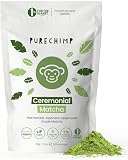
Best for everyday milk drinks: PureChimp Ceremonial Grade Matcha, 100g
Verdict: a British brand that names Kagoshima on the listing and prices at 33.9p a bowl in the 100g tin, against 40p a bowl in its own 50g tin at £9.99. If you already drink it daily, the bigger tin is the same tea for about 15 per cent less a cup.
Behind this verdict: both PureChimp listings read on Amazon UK on 9 September 2026, 100g at £16.96 and 50g at £9.99, giving 33.9p and 40p a bowl. The listing names the region but not the harvest, and says nothing about how the powder is packed against light, which is what actually decides how it ages once opened.
As an Amazon Associate I earn from qualifying purchases. (paid link)
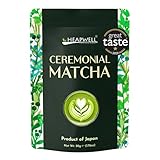
Best under £10: Heapwell Classic Ceremonial Grade Matcha, 50g
Verdict: under a tenner, 40p a bowl, and it names Shizuoka. That combination is rarer than it should be: most tins in this price bracket name nothing at all.
Behind this verdict: the seller’s own Amazon UK listing, read 9 September 2026, which names Shizuoka; bowl price is £9.99 over 50g. No harvest is stated, and the listing’s “classic” and “ceremonial” wording is the seller’s own description rather than a graded standard anyone administers.
As an Amazon Associate I earn from qualifying purchases. (paid link)
Best overall: Ocha & Co. Shizuoka Organic Matcha, 100g
Verdict: the best evidenced tin in the whole set, and the only 100g one that names a region, a first harvest and a cultivar, with JAS organic certification on top. At 49.9p a bowl it costs four times the cheapest tin here, and it is the only pick where you can actually check most of what you are paying for.
Behind this verdict: the seller’s own Amazon UK listing, read 9 September 2026, which states Shizuoka, first harvest, a named cultivar and ECO JAS organic certification; bowl price is £24.95 over 100g. It still does not say which year that first harvest was, so “first harvest” tells you the picking, not the age.

As an Amazon Associate I earn from qualifying purchases. (paid link)
Best small organic tin: Clearspring Organic Japanese Premium Grade Matcha, 40g
Verdict: a UK organic brand you will also find in health food shops, naming Uji, at 50p a bowl. Like Sevenhills it calls its tea “premium grade” rather than ceremonial, which is the more honest label given that neither phrase is defined by anybody.
Behind this verdict: the seller’s own Amazon UK listing, read 9 September 2026, which names Uji and organic certification; bowl price is £9.99 over 40g. No harvest is stated, and we cannot say whether “premium grade” here means anything different from “ceremonial grade” elsewhere, because neither term has a published definition to compare them against.

As an Amazon Associate I earn from qualifying purchases. (paid link)
The one everyone buys: PerfectTed Organic Matcha, 30g
Verdict: the brand that put matcha in front of most British buyers, and the top result in the popularity-sorted listings. Its listing claims organic, shade-grown, farm-direct and first-harvest leaf, which is more than most. It never says where in Japan, and at 59.9p a bowl in a 30g tin you are paying nearly five times the cheapest bowl here.
Behind this verdict: the seller’s own Amazon UK listing, read 9 September 2026, which claims first-harvest, shade-grown, organic leaf sourced directly from Japan; bowl price is £8.99 over 30g. The listing names no prefecture, garden or harvest year, so the first-harvest claim cannot be checked against anything.

As an Amazon Associate I earn from qualifying purchases. (paid link)
Best for drinking straight: Ocha & Co. Kyoto Uji Matcha, 50g
Verdict: the most expensive bowl here at 99.8p, and the one aimed squarely at drinking whisked with water rather than buried in milk. Uji, first harvest, named cultivar, JAS organic. If you are going to pay the ceremonial premium, this is the sort of listing that at least puts something on the record in exchange.
Behind this verdict: the seller’s own Amazon UK listing, read 9 September 2026, which states Kyoto Uji, first harvest, a named cultivar and organic certification; bowl price is £24.95 over 50g. Whether it tastes better than the 12.2p bowl is exactly the question desk research cannot answer, and we do not claim it does.

As an Amazon Associate I earn from qualifying purchases. (paid link)
What 29 matcha tins claim, and the one thing none of them tells you
Matcha is a ground fresh leaf. It fades, dulls and flattens with age, which is why colour is the standard shorthand for quality. So the single most useful fact about a tin is when the tea was picked.
None of the 29 listings we read on 9 September 2026 states a harvest year. Not the £4.99 one and not the £24.95 one. Six listings contain a year somewhere in their copy, and in every case it was an award, a founding date or an Amazon listing date rather than a crop. Call it the undated matcha tin: a product sold on freshness that never says how fresh it is. One listing of the 29 mentions shelf life at all.
The grade word does no better. Twenty-five of the 29 are sold as “ceremonial grade”. Not one of the 29 explains what that means, and none mentions that it is a marketing term with no legal or industry definition behind it, which is why a seller can print it on a 6p-a-gram tin and an 83p-a-gram tin alike.
That gap has a price. Among the tins carrying the words “ceremonial grade”, the cheapest bowl is 12.2p and the dearest is £1.66. That is the ceremonial grade spread: a thirteenfold difference in what a bowl costs, sitting behind one phrase that nobody defines and nobody audits.
What sellers will put in writing, out of 29 listings read on 9 September 2026:
| What the listing says | Listings |
|---|---|
| Sold as “ceremonial grade” | 25 of 29 |
| Says the tea is Japanese | 25 of 29 |
| Names a shade-growing or tencha process | 18 of 29 |
| Names a growing region or prefecture | 16 of 29 |
| Claims a first or spring harvest | 10 of 29 |
| Names the cultivar | 4 of 29 |
| States the harvest year | 0 of 29 |
| Explains what “ceremonial grade” means | 0 of 29 |
Eight of the 25 tins sold as ceremonial grade name neither a region nor a harvest. On those, the grade word is the entire claim.
Who is answering “best matcha UK”, and what they leave out
We read page one of google.co.uk for best matcha uk on 9 September 2026. Nine results. Four of them are matcha sellers: three brand sites and one brand’s own beginner’s guide. Two are user posts, on Reddit and TikTok, and Reddit holds the top spot. Three are editorial guides.
Of the four readable guides on that page, three describe tasting the products, which is more than this page does. But none of the four states a harvest year for any product, one gives a price per serving, and one mentions in passing that matcha labels are unregulated. So on the question of how old the tea is, the sellers and the reviewers give the same answer, which is none.
That is the honest shape of this page’s advantage. We have not tasted anything. What we have done is count what the market will and will not put in writing, and price every tin per bowl instead of per tin. Our methodology page sets out what our research cannot tell you.
How UK matcha demand has actually moved
Matcha’s rise in Britain is real and it is large. Using Google Trends GB weekly interest for matcha, the annual mean ran 12.0 in 2022, 17.1 in 2023, 26.6 in 2024, 58.4 in 2025 and 75.8 across 2026 to 30 August. On the same index, the busiest week in five years was the week of 15 February 2026, not a summer week.
Two things follow that are worth knowing before you buy.
- The growth is slowing. Comparing each 2026 week with the same week of 2025, UK matcha searches ran an average of 45.6% ahead through January to April, and 12.1% ahead from May to the end of August. The trend is still up. The rate of climb has roughly halved.
- Autumn is usually the quiet part of the year. In 2025, weekly interest fell from an August mean of 68.0 to an October mean of 53.5, a drop of about a fifth. October came in below August in three of the past four years; 2024 was the exception, when it rose.
Measured 9 September 2026 from a single five-year Google Trends GB request so every week sits on one scale. The most recent partial week is excluded. Re-run the query and check the numbers yourself. We publish a weekly UK Demand Index on the same source.
How to buy matcha without paying for the word
- Work in bowls, not tins. Divide the price by the grams and double it. A 30g tin at £8.99 and a 100g tin at £16.96 look eight pounds apart on the shelf and are 26p a bowl apart in the cup.
- Buy the size you will finish. Since nothing on the shelf tells you the harvest, the only freshness you control is your own turnover. A 200g tin is around 100 bowls. If that is six months of drinking, buy 50g.
- Treat “ceremonial grade” as packaging. It appears on 25 of the 29 tins we read, across a thirteenfold range of bowl prices. It is not a grade in any administered sense.
- Prefer what can be checked. A named prefecture, a named cultivar and an organic certification are claims a seller can be held to. “Premium”, “classic”, “supreme” and “AAA” are not.
- Culinary grade is not a lesser product, it is a different one. If it is going into a latte, a smoothie or a cake, the cheaper powders here do the job and the difference is largely lost under milk.
- Judge the colour when it arrives. Fresh matcha is a vivid, almost fluorescent green. Dull, khaki or yellow-brown powder is older or lower grade, whatever the tin says.
Matcha: your questions
What does “ceremonial grade” actually mean?
Commercially, very little. It is a marketing term with no legal or industry definition and no body that administers it, so any seller can use it. In the 29 Amazon UK listings we read on 9 September 2026, 25 used it and none explained it. Broadly it is meant to signal younger, shade-grown leaf intended for whisking and drinking straight, as opposed to culinary grade meant for lattes and baking, but nothing stops it appearing on either.
How much should matcha cost in the UK?
On 9 September 2026 the 29 Amazon UK tins we read ran from 5p to 83p a gram, which is 10p to £1.66 for a 2g bowl. Anything under about 15p a bowl is a bulk or culinary buy, 30p to 50p is the everyday middle, and above 60p you are paying for a small tin, a named garden, or the word on the front.
How much caffeine is in a bowl of matcha?
A 2g serving is commonly put at around 60 to 80mg of caffeine, in the range of a strong espresso, though published figures vary widely with the leaf, the harvest and how much powder you use. Because you drink the whole leaf rather than an infusion, matcha delivers more caffeine per gram than steeped green tea.
Does matcha go off?
It does not become unsafe quickly, but it dulls. Ground leaf loses colour and aroma with exposure to light, air, heat and moisture, which is why it is sold in opaque tins and why an opened tin is best kept sealed, cool and dark and finished within a couple of months. None of the 29 listings we read states a harvest date, so how old the powder already is when it reaches you is not something a UK buyer can currently find out.
Is more expensive matcha better?
Not reliably, and price alone will not tell you. What we can say from the listings is that the dearer tins are more likely to name a region, a harvest and a cultivar, and those are the claims a buyer can hold a seller to. We have not tasted these products and do not claim the expensive ones taste better.
Is UK matcha from Japan or China?
Both are sold here. Of the 29 listings read on 9 September 2026, 25 say the tea is Japanese and 16 name a specific growing region such as Uji, Shizuoka or Kagoshima. Where a listing says only “matcha powder” with no country and no region, the listing itself is the reason you cannot tell.