
The short version
- Cost per burning hour across the top ten of Amazon’s Aromatherapy Candles chart on 1 October 2026 runs from 5.7p to 76p. That is a thirteenfold spread on a shelf where every jar looks much the same.
- Shelf price tells you almost nothing. The Neom travel candle costs £15.20 and the WoodWick Large Hourglass £16.49, so the Neom is cheaper to buy and six times dearer per hour.
- Every burn time on this page is the maker’s own claim from the listing, not a figure we measured. Neom’s listing asks you to burn two to four hours at a time, which is a reminder that how you burn it moves the number.
- Two British Standards cover candles sold here: BS EN 15493 for fire safety and BS EN 15494 for safety labels. The 2019 revision of BS EN 15494 removed the option to put the safety information in a leaflet, so it belongs on the product.
Autumn candles are a seasonal impulse buy, which is exactly why the pricing gets away with so much. A jar is a jar. You pick one up because it smells of cinnamon and it costs about fifteen quid, and nothing on the shelf invites you to work out what fifteen quid actually buys.
So we worked it out. We took the top ten of Amazon UK’s Aromatherapy Candles chart on 1 October 2026, read the price and the stated burn time off each listing, and divided one by the other.



As an Amazon Associate I earn from qualifying purchases. (paid link)
Prices and specs last checked by Look Into on 1 October 2026 · how we picked
What a burning hour costs
The cheapest hour on the chart is 5.7p. The dearest is 76p. Both come from candles priced within a couple of pounds of each other.
| Candle | Price | Stated burn time | Cost per hour |
|---|---|---|---|
| Dsclavacy 12 pack, 2.5oz each | £13.59 | 240 hours for the pack | 5.7p |
| TTRWIN 4 pack, 100g each | £9.99 | About 25 hours each, 100 total | 10.0p |
| WoodWick Large Hourglass | £16.49 | Up to 130 hours | 12.7p |
| TRINIDa Autumn 3 pack, 3.5oz | £15.19 | 90 to 105 hours for the set | 14.5p to 16.9p |
| Auelife Autumn 7oz | £14.99 | About 50 hours | 30.0p |
| Neom Happiness travel, 185g | £15.20 | Up to 20 hours | 76.0p |
The ranking by price and the ranking by cost per hour are close to unrelated. Buy on the sticker and you can pay six times over the odds without ever seeing the number that would have told you.
One honest caveat, and it matters. These burn times are manufacturer claims printed on a sales listing, and no retailer has to prove them. We have not lit any of these candles. A claimed hour is also not a fixed quantity: Neom’s own listing tells you to burn it for a minimum of two hours and a maximum of four at a time, because short burns tunnel the wax and long ones overheat the jar. Burn any of these badly and you will get fewer hours than the label promises.
The two standards behind a candle sold in Britain
Scent is unregulated in the sense that nobody can tell you your pumpkin spice is wrong. Safety is not. Two British Standards apply.
BS EN 15493 is the fire safety specification. It sets requirements intended to keep a candle reasonably safe in use, covering things like how it burns, how readily it ignites, how the flame behaves and whether the thing stays upright.
BS EN 15494 covers the product safety label. The 2019 revision is the interesting one, because it removed the option to hand over the safety information in a separate instruction leaflet. The warnings are meant to be on the product. That gives you something you can actually check in a photograph before you buy: the never-leave-burning symbol, the keep-away-from-children symbol, the minimum spacing between candles. A listing whose every image is a styled flat lay with no sight of the base label is telling you less than one that shows it.
None of this makes an unlabelled candle a fire hazard, and we are not suggesting the ones below are non-compliant. It is simply the one quality signal on a candle listing that is written down in a standard, not invented by the brand.
How we picked these
We started from Amazon UK’s Aromatherapy Candles chart read on 1 October 2026, and chose six that span the cost-per-hour range, not six that sit at the top of the chart. Prices, pack sizes and burn times were read from each live product page on the day of writing, and the cost per hour is our own arithmetic on those two figures. We have not burned these candles and we do not claim to have tested them. Where a listing gives a range we have shown the range.
The six we would buy
Dsclavacy scented candles, 12 pack
£13.59 on 1 October 2026 · 240 hours claimed for the pack · 5.7p per hour
Twelve 2.5oz tins, twelve different scents, and by a distance the lowest cost per hour we found. The listing claims 15 to 20 hours each and about 240 for the set. If you burn candles as background most evenings, this is the one that stops the habit being expensive.
The catch: twelve scents means you chose none of them, and apple cinnamon and fig are in the same box as lemon and freesia. Small tins also burn hotter near the end and tunnel easily, so the 240 hours assumes better discipline than most people manage.
WoodWick Large Hourglass, Linen
£16.49 on 1 October 2026 · up to 130 hours claimed · 12.7p per hour
The most expensive candle on this page to buy and one of the cheapest to run, which is the whole argument of this article in a single jar. It is also the only one here that puts its burn time in the product title instead of burying it in the bullets. The wooden wick crackles, which people either love or find distracting.
The catch: Linen is clean laundry, not autumn. If you came here for pumpkin and woodsmoke this is the wrong scent in the right jar, and the autumn scents in the same range are not always the same price.
TTRWIN scented candle gift set, 4 pack
£9.99 on 1 October 2026 · about 25 hours each, 100 for the set · 10.0p per hour
Top of the Aromatherapy Candles chart on the day we looked, and the cheapest thing here to buy outright. Four 100g soy jars, a hundred claimed hours between them, and a second-best cost per hour. As a gift that does not look like a ten pound gift, it is hard to argue with.
The catch: 100g is a small jar, so each one is gone in a few evenings and the set photographs better than it lasts. Being chart number one also means a great many other people are giving it this Christmas.
TRINIDa autumn scented candles, 3 pack
£15.19 on 1 October 2026 · 90 to 105 hours claimed for the set · 14.5p to 16.9p per hour
If the brief is genuinely autumn, not a candle that happens to be on sale in October, this is the sensible pick. Pumpkin and cinnamon, three 3.5oz jars, 30 to 35 hours each by the listing’s own numbers, and a middling cost per hour that buys you a scent actually chosen for the season.
The catch: the maker states a range, not a figure, and the bottom of that range is nearly 17p an hour, which is three times the Dsclavacy. Seasonal scents also date; nobody wants pumpkin in February.
Auelife autumn candle, 7oz vanilla pumpkin
£14.99 on 1 October 2026 · about 50 hours claimed · 30.0p per hour
The autumn-specific jar that was sitting fourth on the chart, and the one most people picturing an autumn candle would actually buy. One large 7oz vessel, vanilla and pumpkin, roughly 50 hours. It looks the part on a mantelpiece in a way a tin of twelve does not.
The catch: 30p an hour is five times the cheapest candle here and more than double the WoodWick, for a jar that costs less than the WoodWick. This is precisely the trap the table above is for.
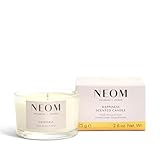
Neom Happiness travel candle, 185g
£15.20 on 1 October 2026 · up to 20 hours claimed · 76.0p per hour
We have included this because leaving it out would be dishonest about what the chart contains. Neom is a real fragrance house, the oils are natural, and plenty of people will tell you it smells better than everything above it. As a present it carries a name the recipient recognises.
The catch: 76p an hour. It is a travel size at a full-size price, and a tenner cheaper than nothing else here while costing thirteen times the Dsclavacy to run. Buy it for the scent and the box, with your eyes open, and not because fifteen pounds sounded reasonable.
Burning them so the hours actually turn up
The claimed burn time assumes you treat the candle properly, and most of the gap between the label and reality comes from two habits.
The first is the short burn. Wax has a memory. If the first burn does not melt the pool out to the full width of the jar, it will tunnel down the middle from then on and you will throw away a ring of unburned wax round the edge. That is why Neom’s listing asks for two hours minimum. Give any wide jar a long first burn and you get a meaningful share of those hours back.
The second is the untrimmed wick. A long wick burns a bigger flame, which eats wax faster and sooties the glass. Trimming to about 5mm before each light is the single cheapest thing you can do to make a candle last.
Questions people ask
Is soy wax cheaper to run than paraffin?
Not reliably, and the listings on this chart do not give you the data to tell. Soy generally burns cooler and slower, which should mean more hours per gram, but burn time also depends on wick size, jar width and fragrance load. Compare the stated hours and the price, not the wax type.
Does a bigger jar always mean a lower cost per hour?
No, and that is the surprise in the table. The Auelife 7oz jar is far bigger than a Dsclavacy tin and costs more than five times as much per hour. Pack size and price do more work than volume.
What safety markings should be on a candle?
BS EN 15494 covers product safety labels, and its 2019 revision removed the option to supply that information as a separate leaflet. In practice you are looking for the standard warning symbols on the product itself: never leave a burning candle unattended, keep away from children and pets, and keep candles apart from each other.
Can I trust the burn times on this page?
Treat them as claims, not measurements. They come from each maker’s own listing, read on 1 October 2026. We have not burned these candles, and nothing obliges a seller to prove the figure. The cost per hour is only as good as the number it divides.
How many hours does an autumn actually need?
Three evenings a week at three hours apiece from October to the end of December is roughly 115 hours. On that basis the Dsclavacy pack covers the season twice over, and the Neom travel candle covers about a sixth of it.
Sources
- BSI, BS EN 15493:2007 Candles. Specification for fire safety
- BSI, BS EN 15494:2019 Candles. Product safety labels
- Amazon.co.uk Best Sellers, Aromatherapy Candles
Prices, pack sizes, chart positions and manufacturer burn-time claims were read on Amazon.co.uk on 1 October 2026 and will have moved since. Cost per hour is our own calculation from the listed price and the maker’s stated burn time; we have not burned these candles or tested their claims. Look Into is a participant in the Amazon EU Associates Programme and earns from qualifying purchases, which never changes what we recommend or what we say about it.
This page is part of Look Into’s UK household cost research. For the costed figures behind it — capture date, method and sources — see the UK Running Cost Index.